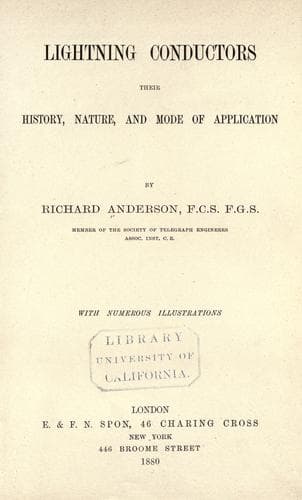
Lightning Conductors: Their History, Nature, and Mode of ApplicationAnderson, Richard, F.C.S.
History
Lightning Conductors: Their History, Nature, and Mode of Application
Anderson, Richard, F.C.S.
Lightning conductors
The system of Mr. Snow Harris for protecting ships against lightning
was similar to that suggested by Mr. Henly in 1774. Instead of hanging
dangling chains from the top of the rigging into the water, he nailed
on to the masts and down to the keel, slightly inlaid in the wood, a
double set of copper plates, overlying each other in such a manner that
the ends of one set were touched by the middle of the other. The plates
were four feet in length, two to five inches wide, and one-eighth of
an inch thick; they had holes drilled in them at distances of six
inches apart, and were secured to the masts and further down by short
copper nails. In order to prevent any break in the conductor at the
junction of the successive masts, a copper plate was led over the cap,
and the continuity preserved at all times by means of a copper hinge
or tumbler which fell against the conductor. It was an altogether
unobjectionable plan for securing protection against lightning, except
that it was liable to fail under imperfect execution. Bad workmanship
necessarily was fatal to it. The numerous copper plates had to be very
neatly and carefully fastened together to ensure metallic continuity,
in the absence of which the electric force might leave the path traced
for it, diverging into neighbouring metallic masses, numerous on board
ships, such as chains and anchors. It was a most costly system from
beginning to end; but as it was, and, for the short time it remained
in use, it accomplished all that was desired. Not one of the ships
fitted with the conductors designed by Mr. Snow Harris was damaged by
lightning, although many were struck, the electric spark in several
cases being so powerful as to melt the too fine metal points on the
top of the masts. However, the new lightning conductors had not to
stand the ordeal of practice for any length of time. One by one the
great wooden ships of war, once the pride and glory of England, went
into peaceful retirement, to be replaced by iron machines, propelled
by steam, metalled from the top of the masts to the water’s edge. It
had been one of the recommendations of Mr. Snow Harris to the Admiralty
that his copper plates, though expensive at first, would always be
worth their money as old metal; and the irony of fate would have
it that the conversion of copper into silver was not to be long in
waiting. Before the death of the inventor, which occurred in January
1867, his lightning conductors were fast disappearing from the ships
on which they were placed. From the windows of his villa at Plymouth,
Sir William Snow Harris could see a fleet of ironclads, dispensing with
conductors, floating on the sea.
Public-domain text, read in full here on John Shaqi.
Reviews
Reviews
No reviews yet
Be the first to share your thoughts on this work.
Elsewhere in the archive
Join the Discussion
Join the discussion
Sign in to leave a comment or review.
Sign InorCreate an account