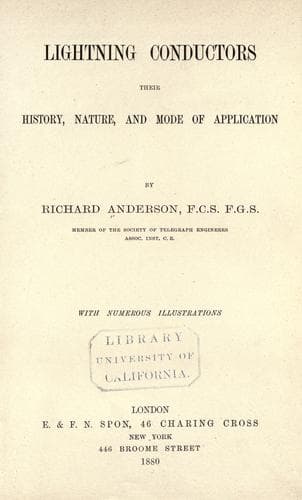
Lightning Conductors: Their History, Nature, and Mode of ApplicationAnderson, Richard, F.C.S.
History
Lightning Conductors: Their History, Nature, and Mode of Application
Anderson, Richard, F.C.S.
Lightning conductors
Notwithstanding the short use of his own special naval work which gave
him fame, Sir William Snow Harris effected much in the interest of
lightning protection in general. He was one of the few men in England
who insisted that it was the duty of the Government, as well as of
private individuals, to place lightning conductors upon all objects
liable to be struck, arguing that it was little less than criminal
to neglect such a simple protection against overwhelming danger. It
was with some degree of vehemence, though not more perhaps than was
requisite, that he stood out against those who objected to conductors
because they ‘attracted’ lightning. Such assertion will, at the present
day, be regarded as foolish by all persons possessed of the least
scientific knowledge; but this was not by any means the case forty or
fifty years ago, when even well-educated men denounced conductors.
A civil engineer in the service of the British Government, Mr. F.
McTaggart, sent to Canada in 1826, recommended openly the pulling-down
of all lightning conductors in that colony, and this too in the name
of ‘science,’ of which he held himself to be an enlightened disciple.
‘Science,’ wrote Mr. McTaggart, in a book he published,[2] ‘has every
cause to dread the thunder-rods of Franklin; they attract destruction,
and houses are safer without than with them. Were they able to carry
off the fluid they have the means of attracting, then there could be no
danger; but this they are by no means able to do.’ Had such reasonings
as these been merely the senseless talk of a few individuals, the harm
done might not have been great. But it was quite otherwise. Men of
power and position, if not of high education, were imbued profoundly
with the same ideas as Mr. McTaggart, as evidenced in at least one
striking instance, which would be scarcely credible were it not on
official record. In the year 1838, the Governor-General and Council of
the East India Company actually ordered that all the lightning rods
should be removed from their public buildings, including the arsenals
and powder magazines, throughout India. The rulers of the great country
had come to their decision, as they stated, by the advice of their
‘scientific officers,’ who all apparently shared Mr. McTaggart’s belief
of the perils of ‘the thunder rods of Franklin.’ It was partly on the
representation of the energetic vindicator of lightning conductors
in Plymouth, that the order for their destruction in India was soon
countermanded by the authorities in Leadenhall Street, but not before
several buildings had been destroyed, among them a large magazine at
Dumdum, and a corning-house at Magazine. As often before, so now,
lightning itself proved the most powerful advocate of conductors, and
in India they were more quickly set up than they had been thrown down.
[2] _Three Years in Canada._ 8vo. London, 1829.
Public-domain text, read in full here on John Shaqi.
Reviews
Reviews
No reviews yet
Be the first to share your thoughts on this work.
Elsewhere in the archive
Join the Discussion
Join the discussion
Sign in to leave a comment or review.
Sign InorCreate an account