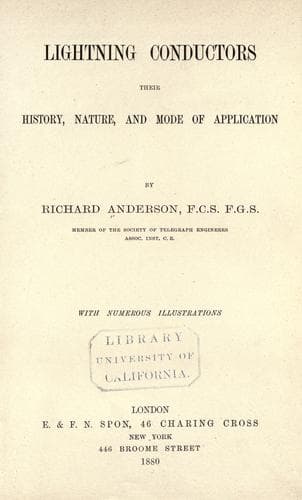
Lightning Conductors: Their History, Nature, and Mode of ApplicationAnderson, Richard, F.C.S.
History
Lightning Conductors: Their History, Nature, and Mode of Application
Anderson, Richard, F.C.S.
Lightning conductors
bad conductors, occasioning sometimes the electric force to leave its
traced course, and fly off in some other direction. It is probable
that, in several well-authenticated instances in which this really did
happen, the joints were eaten away by oxidation, as in the case of
the chains; still, the effect of such occurrences was all the same.
The joining of strips of lead together was a far easier task than
that of handling iron in the same way, particularly for inexperienced
workmen, and thus the employment of the metal continued for some
time. However, it had to be abandoned gradually, on account of its
manifest disadvantages. Its extreme softness, which made it liable to
be broken by any accident, was one of them, and, still more so, its
want of conducting power--only about one-half that of iron. Thus leaden
conductors slowly went out of use, except in the form in which they
still act often to great advantage, that of water-pipes.
Among all the experiments made for producing the most perfect lightning
conductors, the one which created the greatest attention, some fifty
years ago, both on the Continent and in England, was the employment
of ropes made of brass wire. They were first recommended about the
year 1815 by a professor at the University of Munich, J. C. von Yelin,
distinguished for his researches into the nature of thunderstorms.
Through his influence most of the public edifices of Bavaria, more
particularly the churches, were provided with conductors of brass
ropes; and within a few years their employment became so popular,
owing to the ease with which they could be attached to all buildings,
that even the Roman Catholic clergy changed their attitude, and,
from being opposed to ‘heretical rods,’ advocated their extension in
every direction. But it was not long before the trust in brass ropes
as protectors against lightning was rudely shaken. Several instances
occurred in which buildings so protected were struck and damaged by
lightning, and at last there came a case which attracted the widest
attention, leading, on account of its supposed importance, to the
institution of a Royal Commission to report thereon. The little town
of Rosstall, in Franconia, Bavaria, had a church the steeple of which
was 156 feet high; and, standing on the brow of a hill, it overlooked
the country far and wide, visible for many miles. Necessarily much
exposed to the influence of lightning clouds, it had been provided
with one of the best brass-wire conductors, designed by Professor von
Yelin himself, and made of unusual thickness, being over an inch in
diameter. Nevertheless, on the evening of April 30, 1822, while a dark
storm-cloud, of extraordinary thickness, was passing over Rosstall, a
heavy flash of lightning was seen to fall vertically upon the church
steeple, followed by a terrible peal of thunder, which seemed to shake
the earth. When people looked up they beheld the church clock thrown
Public-domain text, read in full here on John Shaqi.
Reviews
Reviews
No reviews yet
Be the first to share your thoughts on this work.
Elsewhere in the archive
Join the Discussion
Join the discussion
Sign in to leave a comment or review.
Sign InorCreate an account