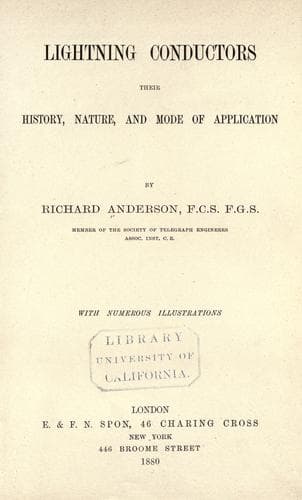
Lightning Conductors: Their History, Nature, and Mode of ApplicationAnderson, Richard, F.C.S.
History
Lightning Conductors: Their History, Nature, and Mode of Application
Anderson, Richard, F.C.S.
Lightning conductors
The use of iron chains as conductors gave rise to very many fatal
accidents, and for a time resulted in an outcry that the system
itself could not be depended upon, as it was known to be not always
efficacious. Lists were published of numerous instances in which
buildings with what were supposed to be the best conductors were struck
by lightning, from which it was argued that Franklin’s great discovery
of the electric force always seeking a metallic path to the earth
was a myth. It was not till some painstaking scientific men, deeply
interested in the subject, had set to work to discover the causes
of the failure, that the whole became plain enough. The chains, in
some of the instances in which they had proved inefficient lightning
conductors, were found to be corroded to such an extent as barely to
hang together. Of course this corrosion would impair the efficiency
of the conductor by reducing the quantity of metal; but the chief
objection to the use of chains lies in the fact long ago pointed out
by Mr. Newall, that even supposing a chain were formed of links of
half-inch copper rods, and were perfectly bright and clean, the area
of the conductor is reduced to a mere point where the links touch each
other, and the resistance becomes so great in such a small conductor
that instances have been recorded of the fusion of the links. In other
cases, as in that of H.M.S. ‘Ætna’ in 1830, the chain was boomed out,
and did not touch the water!
Simultaneously with the chains, there was trial made, in several
Continental states, and also in England, of several other metallic
conductors besides iron. Tin and lead had both their advocates, but
the latter more than the former, on account of its far lower price. As
regards tin, it had really no advantages whatever over iron, except
pliability and non-oxidation. Against this was to be set that it was
much more expensive than iron, with only about the same conducting
power, according to Becquerel, Ohm, and other investigators. Professor
Lenz, it is true, ranked tin very much higher, asserting, from
experiments of his own, that its power of conductivity was nearly twice
that of iron; and it was partly owing to his great influence that
the metal obtained a trial in several countries, more particularly
in Russia and in the United States of America. Still, the result was
not satisfactory on many accounts, and its price alone brought tin
to be soon abandoned as a conductor. Lead had a far longer trial.
Its cheapness recommended it strongly, and equally so its extreme
pliability. One of the greatest difficulties of the constructors of
‘Franklin rods,’ when first they came into demand, was to make the
iron pieces fit properly around sharp corners of buildings, either
by bending them in fire, or, as was more commonly done, soldering
them together, or employing screws and other joints. But it was early
discovered that these junctions, when occurring at acute angles, were
Public-domain text, read in full here on John Shaqi.
Reviews
Reviews
No reviews yet
Be the first to share your thoughts on this work.
Elsewhere in the archive
Join the Discussion
Join the discussion
Sign in to leave a comment or review.
Sign InorCreate an account