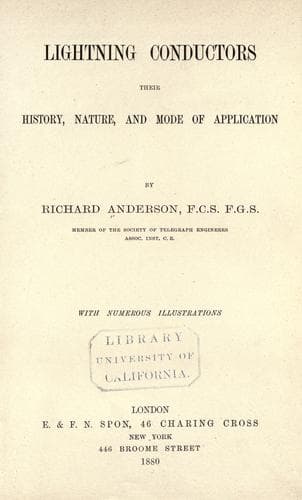
Lightning Conductors: Their History, Nature, and Mode of ApplicationAnderson, Richard, F.C.S.
History
Lightning Conductors: Their History, Nature, and Mode of Application
Anderson, Richard, F.C.S.
Lightning conductors
That copper should not have been employed, long before brass and other
metals, in serving mainly for lightning conductors, its pre-eminence
for this purpose being undisputed, would seem a strange fact, were
it not explicable on several grounds. The first was the cost of
the metal, which, though varying in price, is seldom less than six
or seven times that of iron. It was needless for the advocates of
copper as conductors--and there were not a few from the time its
high conductive power had been demonstrated--to say that if copper
was six times as dear as iron, it was likewise six times better as a
carrier of the electric force, and that consequently the price, in
respect of applicability for lightning protection, was in reality the
same. But the reply to this was that copper, being one of the most
expensive metals, except the so-called ‘precious’ ones, was exposed
to the temptation of theft, and ought therefore not to be employed,
since it was possible that vagrants, or other people, might tear off
at any time the, in more than one sense, valuable pieces of metal
protecting buildings against destruction from lightning. The argument,
perhaps, was not worth much, but a better one not mentioned was in the
background. It was, till quite recent times, an achievement of the
greatest difficulty to manufacture long rods or bands of sufficiently
pure copper to serve as lightning conductors. Sir William Snow Harris
attempted, as already related, to get over this impediment by taking
short plates, and fastening them together, and over each other, by
copper nails. But this process, besides being enormously expensive,
was in many other respects unsatisfactory, notably in that it made a
shifting of the plates possible, and by the destruction of a few of
them ruined the whole system. The pith and substance of the whole was
the technical difficulty of hammering or drawing pure copper out into
great lengths. That it must be pure was essential, the fact being
thoroughly established that the electric conductivity of copper,
mixed with impurities such as arsenic, is often not two-thirds, and
sometimes not as much as one-half, that of the pure metal. This was
conclusively shown by Sir William Thomson in a series of researches,
and likewise by that distinguished investigator in the conductivity of
metals, Professor Matthiessen. The latter, while placing copper on the
same rank with silver, and far above gold--100 to 78--furnished the
following instructive list as to the relative value of different kinds
of copper:—
Pure copper 100·00
Best American copper 92·57
Australian copper 88·86
Russian copper 59·34
Spanish ‘Rio Tinto’ copper 14·24
Public-domain text, read in full here on John Shaqi.
Reviews
Reviews
No reviews yet
Be the first to share your thoughts on this work.
Elsewhere in the archive
Join the Discussion
Join the discussion
Sign in to leave a comment or review.
Sign InorCreate an account