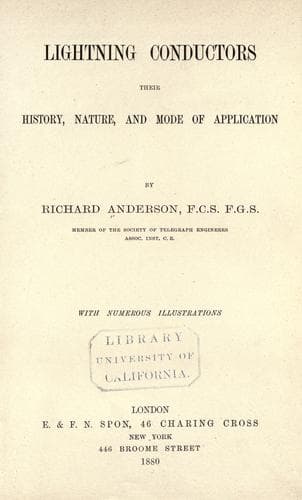
Lightning Conductors: Their History, Nature, and Mode of ApplicationAnderson, Richard, F.C.S.
History
Lightning Conductors: Their History, Nature, and Mode of Application
Anderson, Richard, F.C.S.
Lightning conductors
It will be seen that, according to the investigations of Professor
Matthiessen, admitted on all hands to be correct, the copper lowest
in the list, the ‘Rio Tinto,’ is barely equal to iron in electrical
conductivity, and, not having the hardness of the latter metal, would
be in every way inferior to it as a lightning protector. The employment
of the purest copper therefore became an essential point in the
manufacture of lightning conductors.
Fortunately, the difficulty was solved, at an earlier period than might
have been expected, by the demand for submarine cables. These had to
be made of wires of the highest possible electrical conductivity, and
the matter being one of high financial and commercial importance,
manufacturers soon began to use the utmost care in selecting ores
containing the smallest amount of metallic impurities. We believe
the lightning conductors now manufactured at the extensive works of
Mr. R. S. Newall, F.R.S., established at Gateshead on Tyne about
forty years ago, have generally a conductivity of 93 per cent. of
pure copper. It was laid down by one of the most eminent scientific
men of the day, not long ago, that the three principal qualities of
a good lightning conductor ought to be a maximum of conductivity, of
durability, and of flexibility that could be obtained, and there is
nothing coming up to this standard so well as ropes of pure copper.
CHAPTER X.
HÔTEL DE VILLE, BRUSSELS, AND WESTMINSTER PALACE.
The systems of lightning-conductors used for the protection of
the Hôtel de Ville and Westminster Palace seem worthy of separate
description, as showing the methods employed by Professor Melsens and
the late Sir William Snow Harris, both eminent authorities in their
respective countries. The two buildings are so entirely distinct in
their character, that it will be seen at once that very different
methods had to be employed in rendering them safe from the effects of
thunderstorms.
Public-domain text, read in full here on John Shaqi.
Reviews
Reviews
No reviews yet
Be the first to share your thoughts on this work.
Elsewhere in the archive
Join the Discussion
Join the discussion
Sign in to leave a comment or review.
Sign InorCreate an account