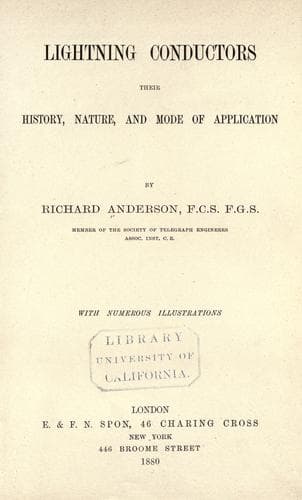
Lightning Conductors: Their History, Nature, and Mode of ApplicationAnderson, Richard, F.C.S.
History
Lightning Conductors: Their History, Nature, and Mode of Application
Anderson, Richard, F.C.S.
Lightning conductors
fixed on the north side of the iron band in which the large points are
fastened; the other end of this wire is left free, and can be utilised
as a conductor for a rheometer or any other electric machine which it
might be thought proper to use permanently for the registration of
lightning striking the conductors.
The eight conductors have each an unbroken continuity of about 310
feet; and they collectively show a continuous section of nearly
one inch--almost half as much again as the limit of safety given
in the ‘Instruction’ of the Paris Academy. Although, in Professor
Melsen’s opinion, rods of somewhat less diameter would have been
amply sufficient for security, he chose the largest size which could
be easily bent to the varying contours of the building, and also
as allowing for the expansion and contraction caused by changes of
temperature. If conductors of only one quarter of an inch diameter
had been used they would, it is true, have shown a total section
just above the limit of the ‘Instruction;’ but, since Coulomb has
demonstrated that tensional electricity is more particularly carried on
the surface of bodies, M. Melsens thinks it is necessary to consider
the action that this surface might exercise in the easy transmission
of electricity. Some old German writers on this subject went so far
as to assert that the conductivity was proportioned to this surface.
They therefore recommended flat bands or hollow tubes in place of rods.
Although exact figures cannot be given as to the effect due to the area
of the surface, M. Melsens considers that it is unquestionable that
the relation of the section to the surface has a marked and definite,
although at present unknown, result. In the case of the Hôtel de Ville,
Brussels, he thinks the eight conductors possess a signal advantage
over one conductor, even though it had a larger section--say one inch.
Experience will doubtless teach how to determine more precisely the
extent of this surface-action.
Public-domain text, read in full here on John Shaqi.
Reviews
Reviews
No reviews yet
Be the first to share your thoughts on this work.
Elsewhere in the archive
Join the Discussion
Join the discussion
Sign in to leave a comment or review.
Sign InorCreate an account