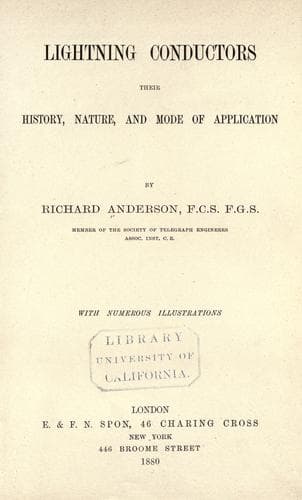
Lightning Conductors: Their History, Nature, and Mode of ApplicationAnderson, Richard, F.C.S.
History
Lightning Conductors: Their History, Nature, and Mode of Application
Anderson, Richard, F.C.S.
Lightning conductors
The Hôtel de Ville, Brussels, one of the finest Gothic structures
in the Netherlands, is fitted with an elaborate system of
lightning-conductors, erected under the superintendence of Professor
Melsens, a distinguished electrician and scientist. He has for many
years advocated the method of employing a great number of small
lightning-rods, in preference to one rod of large size, for the
protection of buildings from the effects of lightning; the main
characteristic of his system being that of covering the building with
a network of metal furnished with very many points, combined with
numerous and ample earth-contacts. This idea has been thoroughly worked
out at the Hôtel de Ville, Brussels; and probably no other building is
so completely guarded from the dangers of thunderstorms. The principal
feature of the Hôtel is a large central building, with a pinnacled
turret, from which rises a lofty spire, nearly three hundred feet high,
and adorned with four galleries, each with corner pinnacles. Upon the
top of this spire is a gilded colossal figure, seventeen feet high, of
St. Michael, holding a naked sword and standing upon a dragon. This
acts as a vane, and the point of the sword forms the highest terminal
conductor of the system. The main block of the Hôtel is ornamented with
six turrets, from each of which springs a small spire. In the rear is
a courtyard formed by buildings annexed to the front main block, and
composing the remaining three sides of this inner quadrangle.
The figure of St. Michael, all the parts of which are rivetted and
soldered together, rests on a pivot of iron, three and a half inches
in diameter, which is deeply embedded in the stone-work of the spire.
The weight of the vane produces a metallic connection with the pivot,
and the top of the platform in which the pivot is fixed is covered with
sheet-copper. Around this and in connection with the pivot are fixed
eight perpendicular galvanised iron conductors, two-fifths of an inch
in diameter, and provided with five points each. A flash of lightning
striking the statue would thus reach the pivot and then be divided
between the eight conductors. Just below the platform are placed, at
an angle of 45 degrees, eight large points six and a half feet long.
These are fastened to an iron band which encircles the spire, and are
connected with the eight conductors by means of a mass of zinc. Thus
the pivot of the statue, and consequently the statue itself, the eight
conductors, the eight large points, and the forty small points on the
conductors, constitute a protection which dominates the edifice, and
represents a circular space of about five and a half yards in diameter;
that is, between the extremities of the large points which project from
under the platform. In this manner a flash of lightning is instantly
distributed and conveyed by the conductors to the ground. It may be
mentioned here that a thin copper wire, insulated by three coatings, is
Public-domain text, read in full here on John Shaqi.
Reviews
Reviews
No reviews yet
Be the first to share your thoughts on this work.
Elsewhere in the archive
Join the Discussion
Join the discussion
Sign in to leave a comment or review.
Sign InorCreate an account