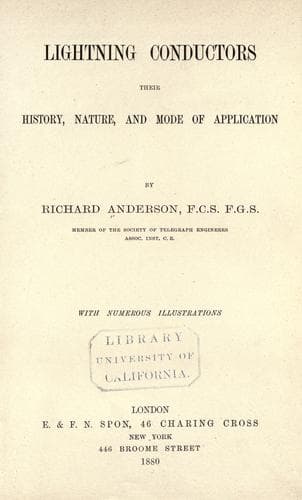
Lightning Conductors: Their History, Nature, and Mode of ApplicationAnderson, Richard, F.C.S.
History
Lightning Conductors: Their History, Nature, and Mode of Application
Anderson, Richard, F.C.S.
Lightning conductors
l’Hôtel de Ville, and the wires are fixed to it in the same way.
[Illustration: Fig. 4.]
It may be added that the whole of the conductors above-ground--with the
exception of the points--are painted with oil.
Although it is correct that the coke generally placed around the
earth-connection of conductors aids by its good conductivity to bring
them in contact with a large surface of earth, Professor Melsens has
preferred to employ tar, which, it is true, is insulating, but helps
materially to preserve the conductors. It is estimated that the entire
contact between the earth and the underground surface of iron is about
300,000 square yards.
Professor Melsens thinks it is worthy of note that, although copper
is a better conductor of electricity than iron, it has less molecular
strength. Where thin iron wire would simply be beaded--without losing
its conductivity--by an exceptionally strong charge of electricity,
copper wire of the same thickness would by a similar charge be
dissipated to a black powder. Professor Melsens has verified this
in some very interesting experiments. The large use of iron in his
system of conductors on the Hôtel de Ville, Brussels, was rendered
imperative by reason of the enormous cost of sufficient copper for such
an extensive system. But Professor Melsen’s experiments, nevertheless,
give some support to the selection of iron for large and complete works
of this kind.
Sir William Snow Harris, in his arrangements for the protection of
the Palace of Westminster from lightning, has endeavoured to perfect
the general conductivity of the whole mass of the building, and so
make it assume the same relation to the electric discharge as if it
were a complete mass of metal. Westminster Palace differs in one
important respect from the Brussels Hôtel de Ville--the general level
of the roofs is covered with iron coated with zinc, and in many places
directly connected with the earth by cast-iron water-pipes. The roofing
thus constitutes, although imperfectly, and only to a limited extent,
a protection of itself. Sir William Snow Harris had, therefore,
chiefly to provide for those portions of the building which are above
the general level of the roofs, and, by the use of ample conductors
of copper, to make up for the comparatively low conductivity of the
roofing and the iron pipes which connect it with the earth.
Public-domain text, read in full here on John Shaqi.
Reviews
Reviews
No reviews yet
Be the first to share your thoughts on this work.
Elsewhere in the archive
Join the Discussion
Join the discussion
Sign in to leave a comment or review.
Sign InorCreate an account