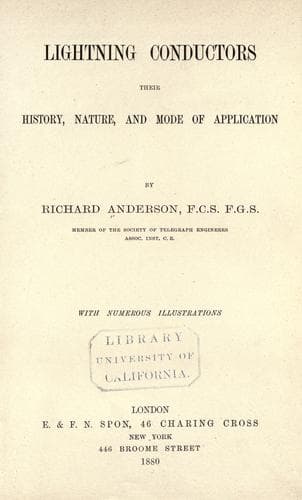
Lightning Conductors: Their History, Nature, and Mode of ApplicationAnderson, Richard, F.C.S.
History
Lightning Conductors: Their History, Nature, and Mode of Application
Anderson, Richard, F.C.S.
Lightning conductors
From the terminal which forms the highest point of the large central
tower is brought a copper tube of two inches diameter and one-eighth
of an inch in thickness, the joints of which are secured by solid
screw-plugs and coupling-pieces. This tube is carried down in the
south-west angle of the tower and fastened to the masonry by metallic
staples. At the junction of the tower with the roofs the tubing is, or
at any rate was, thoroughly connected with the metal of the roof, and
then continued to the earth in as straight a course as practicable,
and there terminates in two projecting branches made of solid copper
rod. By carrying this copper tubing direct to the earth, instead of
terminating it in the metal-work of the roof, the electrical discharge
obtains a conducting medium of the same power throughout, in place of
having to leave a high power for one of lower conductivity.
The Victoria and Clock Towers, which are each 300 feet high, are both
fitted with a copper band, five inches wide and a quarter of an inch
thick. These run down the walls, and are connected with the metal of
the roof, and also with the metallic rail of the staircase within each
tower. The ornamental turrets and pinnacles of St. Stephen’s Porch
are protected by small bands of sheet-copper, two inches wide and
one-eighth of an inch thick; these are also placed in connection with
the metal of the roof.
The north and south towers of the central block, and the north and
south wing towers of the front facing the Thames, have attached to
them bands of sheet-copper running from their respective vanes to the
roofing below. The bands are connected with the metal of the roof, and
are then carried down independently to the earth, in a similar manner
to that adopted on the large central tower.
The only other prominent portion of the edifice is the ventilating
shaft of the House of Commons, where, during the sitting of Parliament,
a coke-fire is generally burning, and from which, therefore, a stream
of warm and rarefied air is constantly being emitted. The conductivity
of an ascending column of warm vapour is known to be great, and
accidents from this cause are of frequent occurrence, although very
often they are not ascribed to their true source. To obviate this
danger, the ventilating shaft is provided with a copper tube conductor,
fixed on its eastern side, and connected with the metal of the roof.
Public-domain text, read in full here on John Shaqi.
Reviews
Reviews
No reviews yet
Be the first to share your thoughts on this work.
Elsewhere in the archive
Join the Discussion
Join the discussion
Sign in to leave a comment or review.
Sign InorCreate an account