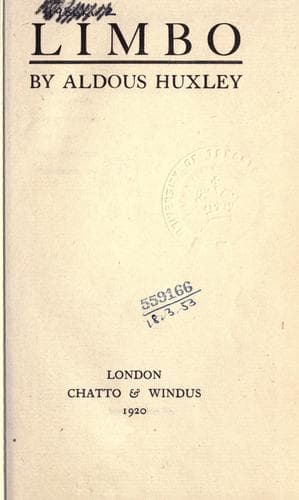
English drama -- 20th century; English fiction -- 20th century; Short stories, English
He leaned across and began talking to Henry Cravister about Pater and
style and books in general. Cravister was amazed at the maturity of
the boy's mind; for he possessed to a remarkable degree that critical
faculty which in the vast majority of boys is--and from their lack of
experience must be--wholly lacking.
"You must come and see me some time when you're in London," Henry
Cravister said to him when the time came for the boys to get back to
their houses. Dick was flattered; he had not said that to any of the
others. He walked home with Gay, laughing and talking quite in his old
fashion. Gay marvelled at the change in his companion; strange,
inexplicable fellow! but it was pleasant to have him back again, to
repossess the lost friend. Arrived in his room, Dick sat down to
attack the last set of mathematical problems that had been set him.
Three hours ago they had appeared utterly incomprehensible; now he
understood them perfectly. His mind was like a giant refreshed,
delighting in its strength.
Next day Mr. Skewbauld congratulated him on his answers.
"You seem quite to have recovered your old form, Greenow," he said.
"Did you take my advice? Paraffin regularly . . ."
Looking back on the events of the last weeks, Dick was disquieted. Mr.
Skewbauld might be wrong in recommending paraffin, but he was surely
right in supposing that something was the matter and required a
remedy. What could it be? He felt so well; but that, of course, proved
nothing. He began doing Müller's exercises, and he bought a jar of
malt extract and a bottle of hypophosphites. After much consultation
of medical handbooks and the encyclopædia, he came to the conclusion
that he was suffering from anæmia of the brain; and for some time one
fixed idea haunted him: Suppose the blood completely ceased to flow to
his brain, suppose he were to fall down suddenly dead or, worse,
become utterly and hopelessly paralysed. . . . Happily the
distractions of Æsop in the summer term were sufficiently numerous and
delightful to divert his mind from this gloomy brooding, and he felt
so well and in such high spirits that it was impossible to go on
seriously believing that he was at death's door. Still, whenever he
thought of the events of those strange weeks he was troubled. He did
not like being confronted by problems which he could not solve. During
the rest of his stay at school he was troubled by no more than the
merest velleities of a relapse. A fit of moon-gazing and incapacity to
understand the higher mathematics had threatened him one time when he
was working rather too strenuously for a scholarship. But a couple of
days' complete rest had staved off the peril. There had been rather a
painful scene, too, at Dick's last School Concert. Oh, those Æsop
concerts! Musically speaking, of course, they are deplorable; but how
rich from all other points of view than the merely æsthetic! The
supreme moment arrives at the very end when three of the most eminent
Public-domain text, read in full here on John Shaqi.
Reviews
Reviews
No reviews yet
Be the first to share your thoughts on this work.
Join the Discussion
Join the discussion
Sign in to leave a comment or review.
Sign InorCreate an account