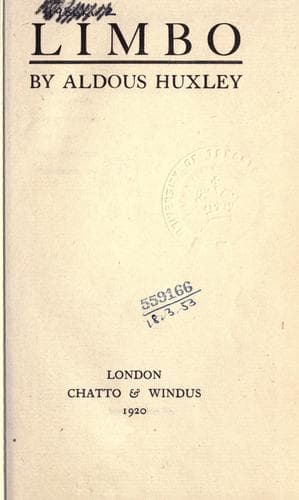
English drama -- 20th century; English fiction -- 20th century; Short stories, English
Dick had taken a cottage on the shore of one of those long salt-water
lochs that give to the west coast of Scotland such a dissipated
appearance on the map. For miles around there was not a living soul
who did not bear the name of Campbell--two families only excepted, one
of whom was called Murray-Drummond and the other Drummond-Murray.
However, it was not for the people that Dick and Millicent had come,
so much as for the landscape, which made up in variety for anything
that the inhabitants might lack. Behind the cottage, in the midst of a
narrow strip of bog lying between the loch and the foot of the
mountains, stood one of the numerous tombs of Ossian, a great barrow
of ancient stones. And a couple of miles away the remains of Deirdre's
Scottish refuge bore witness to the Celtic past. The countryside was
dotted with the black skeletons of mediæval castles. Astonishing
country, convulsed into fantastic mountain shapes, cut and indented by
winding fiords. On summer days the whole of this improbable landscape
became blue and remote and aerially transparent. Its beauty lacked all
verisimilitude. It was for that reason that Dick chose the
neighbourhood for his holidays. After the insistent actuality of
London this frankly unreal coast was particularly refreshing to a
jaded spirit.
"Nous sommes ici en plein romantisme," said Dick on the day of their
arrival, making a comprehensive gesture towards the dream-like
scenery, and for the rest of his holiday he acted the part of a young
romantic of the palmy period. He sat at the foot of Ossian's tomb and
read Lamartine; he declaimed Byron from the summit of the mountains
and Shelley as he rowed along the loch. In the evening he read George
Sand's _Indiana_; he agonized with the pure, but passionate, heroine,
while his admiration for Sir Brown, her English lover, the impassive
giant who never speaks and is always clothed in faultless hunting
costume, knew no bounds. He saturated himself in the verses of Victor
Hugo, and at last almost came to persuade himself that the words,
_Dieu_, _infinité_, _eternité_, with which the works of that
deplorable genius are so profusely sprinkled, actually possessed some
meaning, though what that meaning was he could not, even in his most
romantic transports, discover. Pearl Bellairs, of course, understood
quite clearly their significance, and though she was a very poor
French scholar she used sometimes to be moved almost to tears by the
books she found lying about when she came into existence after
midnight. She even copied out extracts into her notebooks with a view
to using them in her next novel.
"Les plus désespérés sont les chants les plus beaux,
Et j'en sais d'immortels qui sont de purs sanglots,"
was a couplet which struck her as sublime.
Public-domain text, read in full here on John Shaqi.
Reviews
Reviews
No reviews yet
Be the first to share your thoughts on this work.
Join the Discussion
Join the discussion
Sign in to leave a comment or review.
Sign InorCreate an account