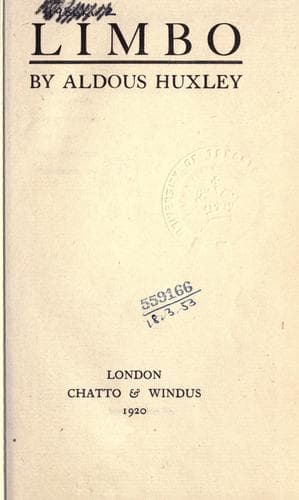
English drama -- 20th century; English fiction -- 20th century; Short stories, English
The South Marylebone Tribunal sat in a gloomy and fetid chamber in a
police station. Dick, who was extremely sensitive to his surroundings,
felt his fatigue and nervousness perceptibly increase as he entered
the room. Five or six pitiable creatures with paralytic mothers or
one-man businesses were briskly disposed of, and then it was Dick's
turn to present himself before his judges. He looked round the court,
nodded to Hyman, smiled at Millicent, who had so far thawed their
wartime coolness as to come and see him condemned, caught other
friendly eyes. It was as though he were about to be electrocuted. The
preliminaries passed off; he found himself answering questions in a
loud, clear voice. Then the Military Representative began to loom
horribly large. The Military Representative was a solicitor's clerk
disguised as a lieutenant in the Army Service Corps. He spoke in an
accent that was more than genteel; it was rich, noble, aristocratic.
Dick tried to remember where he had heard a man speaking like that
before. He had it now. Once when he had been at Oxford after term was
over. He had gone to see the Varieties, which come twice nightly and
with cheap seats to the theatre after the undergraduates have
departed. One of the turns had been a Nut, a descendant of the bloods
and Champagne Charlies of earlier days. A young man in an alpaca
evening suit and a monocle. He had danced, sung a song, spoken some
patter. Sitting in the front row of the stalls, Dick had been able to
see the large, swollen, tuberculous glands in his neck. They wobbled
when he danced or sang. Fascinatingly horrible, those glands; and the
young man, how terribly, painfully pathetic. . . . When the Military
Representative spoke, he could hear again that wretched Nut's
rendering of the Eton and Oxford voice. It unnerved him.
"What is your religion, Mr. Greenow?" the Military Representative
asked.
Fascinated, Dick looked to see whether he too had tuberculous glands.
The Lieutenant had to repeat his question sharply. When he was
irritated, his voice went back to its more natural nasal twang. Dick
recovered his presence of mind.
"I have no religion," he answered.
"But, surely, sir, you must have some kind of religion."
"Well, if I must, if it's in the Army Regulations, you had better put
me down as an Albigensian, or a Bogomile, or, better still, as a
Manichean. One can't find oneself in this court without possessing a
profound sense of the reality and active existence of a power of evil
equal to, if not greater than, the power of good."
"This is rather irrelevant, Mr. Greenow," said the Chairman.
"I apologize." Dick bowed to the court.
"But if," the Military Representative continued--"if your objection is
not religious, may I ask what it is?"
"It is based on a belief that all war is wrong, and that the
solidarity of the human race can only be achieved in practice by
protesting against war, wherever it appears and in whatever form."
Public-domain text, read in full here on John Shaqi.
Reviews
Reviews
No reviews yet
Be the first to share your thoughts on this work.
Join the Discussion
Join the discussion
Sign in to leave a comment or review.
Sign InorCreate an account