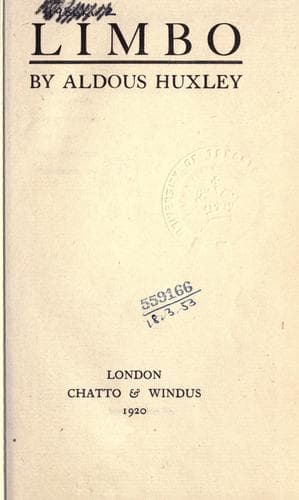
English drama -- 20th century; English fiction -- 20th century; Short stories, English
Dick hated the manual labour of the farm. It was hard, monotonous,
dirty, and depressing. It inhibited almost completely the functions of
his brain. He was unable to think about anything at all; there was no
opportunity to do anything but feel uncomfortable. God had not made
him a Caliban to scatter ordure over fields, to pick up ordure from
cattle-yards. His rôle was Prospero.
"Ban, Ban, Caliban"--it was to that derisive measure that he pumped
water, sawed wood, mowed grass; it was a march for his slow, clotted
feet as he followed the dung-carts up the winding lanes. "Ban, Ban,
Caliban--Ban, Ban, Ban . . ."
"Oh, that bloody old fool Tolstoy," was his profoundest reflection on
a general subject in three months of manual labour and communion with
mother earth.
He hated the work, and his fellow-workers hated him. They mistrusted
him because they could not understand him, taking the silence of his
overpowering shyness for arrogance and the contempt of one class for
another. Dick longed to become friendly with them. His chief trouble
was that he did not know what to say. At meal-times he would spend
long minutes in cudgelling his brains for some suitable remark to
make. And even if he thought of something good, like--"It looks as
though it were going to be a good year for roots," he somehow
hesitated to speak, feeling that such a remark, uttered in his
exquisitely modulated tones, would be, somehow, a little ridiculous.
It was the sort of thing that ought to be said rustically, with plenty
of Z's and long vowels, in the manner of William Barnes. In the end,
for lack of courage to act the yokel's part, he generally remained
silent. While the others were eating their bread and cheese with
laughter and talk, he sat like the skeleton at the feast--a skeleton
that longed to join in the revelry, but had not the power to move its
stony jaws. On the rare occasions that he actually succeeded in
uttering something, the labourers looked at one another in surprise
and alarm, as though it were indeed a skeleton that had spoken.
He was not much more popular with the other inhabitants of the
village. Often, in the evenings, as he was returning from work, the
children would pursue him, yelling. With the unerringly cruel instinct
of the young they had recognized in him a fit object for abuse and
lapidation. An outcast member of another class, from whom that class
in casting him out had withdrawn its protection, an alien in speech
and habit, a criminal, as their zealous schoolmaster lost no
opportunity of reminding them, guilty of the blackest treason against
God and man--he was the obviously predestined victim of childish
persecution. When stones began to fly, and dung and precocious
obscenity, he bowed his head and pretended not to notice that anything
unusual was happening. It was difficult, however, to look quite
dignified.
Public-domain text, read in full here on John Shaqi.
Reviews
Reviews
No reviews yet
Be the first to share your thoughts on this work.
Join the Discussion
Join the discussion
Sign in to leave a comment or review.
Sign InorCreate an account