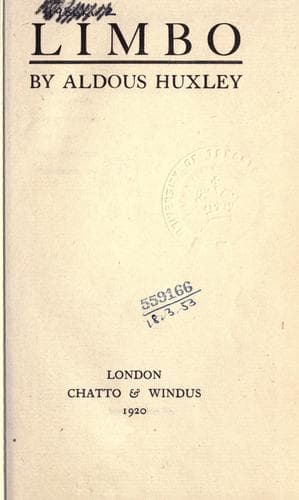
English drama -- 20th century; English fiction -- 20th century; Short stories, English
Mr. Hobart grew visibly paler. Then, assuming a forced smile and
speaking as one speaks to a child or a spoiled animal, he said:
"I see--I see. Over thirty, dear me."
He looked at the bell, which was over by the fireplace at the other
side of the room, and wondered how he should ring it without rousing
the maniac's suspicions.
"Over thirty," the stranger went on. "You know my woman's secret. I am
Miss Pearl Bellairs, the novelist. Perhaps you have read some of my
books. Or are you too busy?"
"Oh no, I've read several," Mr. Hobart replied, smiling more and more
brightly and speaking in even more coaxing and indulgent tones.
"Then we're friends already, Mr. Hobart. Anyone who knows my books,
knows me. My whole heart is in them. Now, you must tell me all about
my poor little vote. I shall be very patriotic with it when the time
comes to use it."
Mr. Hobart saw his opportunity.
"Certainly, Miss Bellairs," he said. "I will ring for my clerk and
we'll--er--we'll take down the details."
He got up, crossed the room, and rang the bell with violence.
"I'll just go and see that he brings the right books," he added, and
darted to the door. Once outside in the passage, he mopped his face
and heaved a sigh of relief. That had been a narrow shave, by Jove. A
loony in the office--dangerous-looking brute, too.
* * * * *
On the following day Dick woke up and found himself in a bare
whitewashed room, sparsely furnished with a little iron bed, a
washstand, a chair, and table. He looked round him in surprise. Where
had he got to this time? He went to the door and tried to open it; it
was locked. An idea entered his mind: he was in barracks somewhere;
the Military Authorities must have got hold of him somehow in spite of
his exemption certificate. Or perhaps Pearl had gone and enlisted.
. . . He turned next to the window, which was barred. Outside, he
could see a courtyard, filled, not with soldiers, as he had expected,
but a curious motley crew of individuals, some men and some women,
wandering hither and thither with an air of complete aimlessness. Very
odd, he thought--very odd. Beyond the courtyard, on the farther side
of a phenomenally high wall, ran a railway line and beyond it a
village, roofed with tile and thatch, and a tall church spire in the
midst. Dick looked carefully at the spire. Didn't he know it?
Surely--yes, those imbricated copper plates with which it was covered,
that gilded ship that served as wind vane, the little gargoyles at the
corner of the tower there could be no doubt; it was Belbury church.
Belbury--that was where the . . . No, no; he wouldn't believe it. But
looking down again into that high-walled courtyard, full of those
queer, aimless folk, he was forced to admit it. The County Asylum
stands at Belbury. He had often noticed it from the train, a huge,
gaunt building of sausage-coloured brick, standing close to the
railway, on the opposite side of the line to Belbury village and
church.
Public-domain text, read in full here on John Shaqi.
Reviews
Reviews
No reviews yet
Be the first to share your thoughts on this work.
Join the Discussion
Join the discussion
Sign in to leave a comment or review.
Sign InorCreate an account