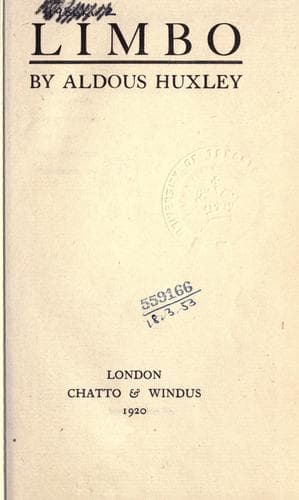
English drama -- 20th century; English fiction -- 20th century; Short stories, English
The pencil stopped writing; even Pearl was beginning to grow tired.
Dick's shouting had died away to a hoarse, faint whisper. Suddenly her
attention was caught by the last words that Dick had written--the
injunction to send his body, if he died, to a hospital for an anatomy.
She put forth a great effort.
"NO. NO," she wrote in huge capitals. "Bury me in a little country
churchyard, with lovely marble angels like the ones in St. George's at
Windsor, over Princess Charlotte's tomb. Not anatomy. Too horrible,
too disgus . . ."
The coma which had blotted out Dick's mind fell now upon hers as well.
Two hours later Dick Greenow was dead; the fingers of his right hand
still grasped a pencil. The scribbled papers were thrown away as being
merely the written ravings of a madman; they were accustomed that sort
of thing at the asylum.
HAPPILY EVER AFTER
I
AT the best of times it is a long way from Chicago to Blaybury in
Wiltshire, but war has fixed between them a great gulf. In the
circumstances, therefore, it seemed an act of singular devotion on the
part of Peter Jacobsen to have come all the way from the Middle West,
in the fourth year of war, on a visit to his old friend Petherton,
when the project entailed a single-handed struggle with two Great
Powers over the question of passports and the risk, when they had been
obtained, of perishing miserably by the way, a victim of
frightfulness.
At the expense of much time and more trouble Jacobsen had at last
arrived; the gulf between Chicago and Blaybury was spanned. In the
hall of Petherton's house a scene of welcome was being enacted under
the dim gaze of six or seven brown family portraits by unknown masters
of the eighteenth and nineteenth centuries.
Old Alfred Petherton, a grey shawl over his shoulders--for he had to
be careful, even in June, of draughts and colds--was shaking his
guest's hand with interminable cordiality.
"My dear boy," he kept repeating, "it _is_ a pleasure to see you. My
dear boy . . ."
Jacobsen limply abandoned his forearm and waited in patience.
"I can never be grateful enough," Mr. Petherton went on--"never
grateful enough to you for having taken all this endless trouble to
come and see an old decrepit man--for that's what I am now, that's
what I am, believe me."
"Oh, I assure you . . ." said Jacobsen, with vague deprecation. "Le
vieux crétin qui pleurniche," he said to himself. French was a
wonderfully expressive language, to be sure.
"My digestion and my heart have got much worse since I saw you last.
But I think I must have told you about that in my letters."
"You did indeed, and I was most grieved to hear it."
"Grieved"--what a curious flavour that word had! Like somebody's tea
which used to recall the most delicious blends of forty years ago. But
it was decidedly the _mot juste_. It had the right obituary note about
it.
Public-domain text, read in full here on John Shaqi.
Reviews
Reviews
No reviews yet
Be the first to share your thoughts on this work.
Join the Discussion
Join the discussion
Sign in to leave a comment or review.
Sign InorCreate an account