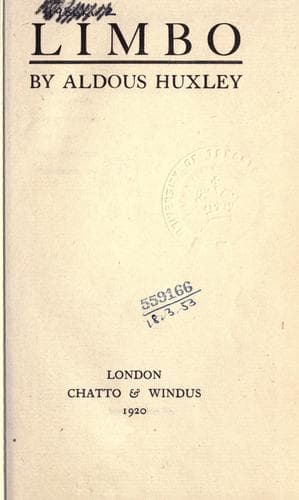
English drama -- 20th century; English fiction -- 20th century; Short stories, English
He spent the rest of the meal in quoting Horace, Catullus, the Greek
Anthology, Petronius, and Sidonius Apollinarius. Marjorie's knowledge
of the dead languages was decidedly limited. Her thoughts were
elsewhere, and it was only dimly and as it were through a mist that
she heard her father murmuring--whether merely to himself or with the
hope of eliciting an answer from somebody, she hardly knew--"Let me
see: how does that epigram go?--that one about the different kinds of
fish and the garlands of roses, by Meleager, or is it Poseidippus?
. . ."
II
GUY and Jacobsen were walking in the Dutch garden, an incongruous
couple. On Guy military servitude had left no outwardly visible mark;
out of uniform, he still looked like a tall, untidy undergraduate; he
stooped and drooped as much as ever; his hair was still bushy and, to
judge by the dim expression of his face, he had not yet learnt to
think imperially. His khaki always looked like a disguise, like the
most absurd fancy dress. Jacobsen trotted beside him, short, fattish,
very sleek, and correct. They talked in a desultory way about things
indifferent. Guy, anxious for a little intellectual exercise after so
many months of discipline, had been trying to inveigle his companion
into a philosophical discussion. Jacobsen consistently eluded his
efforts; he was too lazy to talk seriously; there was no profit that
he could see to be got out of this young man's opinions, and he had
not the faintest desire to make a disciple. He preferred, therefore,
to discuss the war and the weather. It irritated him that people
should want to trespass on the domain of thought--people who had no
right to live anywhere but on the vegetative plane of mere existence.
He wished they would simply be content to _be_ or _do_, not try, so
hopelessly, to think, when only one in a million can think with the
least profit to himself or anyone else.
Out of the corner of his eye he looked at the dark, sensitive face of
his companion; he ought to have gone into business at eighteen, was
Jacobsen's verdict. It was bad for him to think; he wasn't strong
enough.
A great sound of barking broke upon the calm of the garden. Looking
up, the two strollers saw George White running across the green turf
of the croquet lawn with a huge fawn-coloured dog bounding along at
his side.
"Morning," he shouted. He was hatless and out of breath. "I was taking
Bella for a run, and thought I'd look in and see how you all were."
"What a lovely dog!" Jacobsen exclaimed.
"An old English mastiff our--one aboriginal dog. She has a pedigree
going straight back to Edward the Confessor."
Jacobsen began a lively conversation with George on the virtues and
shortcomings of dogs. Bella smelt his calves and then lifted up her
gentle black eyes to look at him. She seemed satisfied.
Public-domain text, read in full here on John Shaqi.
Reviews
Reviews
No reviews yet
Be the first to share your thoughts on this work.
Join the Discussion
Join the discussion
Sign in to leave a comment or review.
Sign InorCreate an account