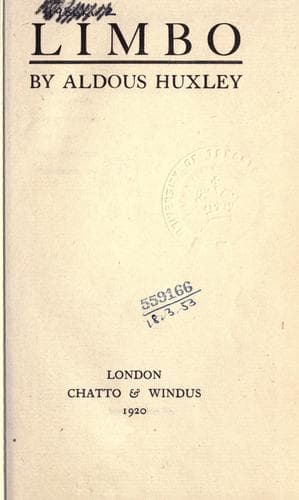
English drama -- 20th century; English fiction -- 20th century; Short stories, English
In the best sense of the word, then, Emberlin was academic. For us who
knew him his rooms were an oasis of aloofness planted secretly in the
heart of the desert of London. He exhaled an atmosphere that combined
the fantastic speculativeness of the undergraduate with the more
mellowed oddity of incredibly wise and antique dons. He was immensely
erudite, but in a wholly unencyclopædic way--a mine of irrelevant
information, as his enemies said of him. He wrote a certain amount,
but, like Mallarmé, avoided publication, deeming it akin to "the
offence of exhibitionism." Once, however, in the folly of youth, some
dozen years ago, he had published a volume of verses. He spent a good
deal of time now in assiduously collecting copies of his book and
burning them. There can be but very few left in the world now. My
friend Cope had the fortune to pick one up the other day--a little
blue book, which he showed me very secretly. I am at a loss to
understand why Emberlin wishes to stamp out all trace of it. There is
nothing to be ashamed of in the book; some of the verses, indeed, are,
in their young ecstatic fashion, good. But they are certainly
conceived in a style that is unlike that of his present poems. Perhaps
it is that which makes him so implacable against them. What he writes
now for very private manuscript circulation is curious stuff. I
confess I prefer the earlier work; I do not like the stony, hard-edged
quality of this sort of thing--the only one I can remember of his
later productions. It is a sonnet on a porcelain figure of a woman,
dug up at Cnossus:
"Her eyes of bright unwinking glaze
All imperturbable do not
Even make pretences to regard
The jutting absence of her stays
Where many a Syrian gallipot
Excites desire with spilth of nard.
The bistred rims above the fard
Of cheeks as red as bergamot
Attest that no shamefaced delays
Will clog fulfilment nor retard
Full payment of the Cyprian's praise
Down to the last remorseful jot.
Hail priestess of we know not what
Strange cult of Mycenean days!"
Regrettably, I cannot remember any of Emberlin's French poems. His
peculiar muse expresses herself better, I think, in that language than
in her native tongue.
Such is Emberlin; such, I should rather say, _was_ he, for, as I
propose to show, he is not now the man that he was when he whispered
so confidentially to me, as I entered the room, that he had made a
discovery about _Discoveries_.
I waited patiently till he had finished his little game of
mystification and, when the moment seemed ripe, I asked him to explain
himself. Emberlin was ready to open out.
Public-domain text, read in full here on John Shaqi.
Reviews
Reviews
No reviews yet
Be the first to share your thoughts on this work.
Join the Discussion
Join the discussion
Sign in to leave a comment or review.
Sign InorCreate an account