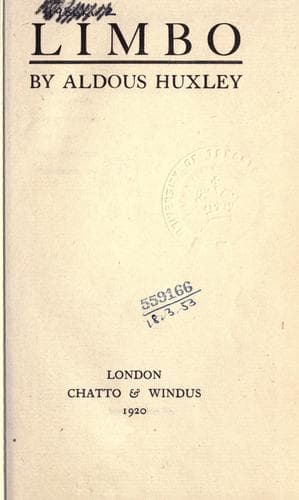
English drama -- 20th century; English fiction -- 20th century; Short stories, English
"Well," he began, "these are the facts--a tedious introduction, I
fear, but necessary. Years ago, when I was first reading Ben Jonson's
_Discoveries_, that queer jotting of his, 'Eupompus gave splendour to
Art by Numbers,' tickled my curiosity. You yourself must have been
struck by the phrase, everybody must have noticed it; and everybody
must have noticed too that no commentator has a word to say on the
subject. That is the way of commentators--the obvious points fulsomely
explained and discussed, the hard passages, about which one might want
to know something passed over in the silence of sheer ignorance.
'Eupompus gave splendour to Art by Numbers'--the absurd phrase stuck
in my head. At one time it positively haunted me. I used to chant it
in my bath, set to music as an anthem. It went like this, so far as I
remember"--and he burst into song: "'Eupompus, Eu-u-pompus gave
sple-e-e-endour . . .'" and so on, through all the repetitions, the
dragged-out rises and falls of a parodied anthem.
"I sing you this," he said when he had finished, "just to show you
what a hold that dreadful sentence took upon my mind. For eight years,
off and on, its senselessness has besieged me. I have looked up
Eupompus in all the obvious books of reference, of course. He is there
all right--Alexandrian artist, eternized by some wretched little
author in some even wretcheder little anecdote, which at the moment I
entirely forget; it had nothing, at any rate, to do with the
embellishment of art by numbers. Long ago I gave up the search as
hopeless; Eupompus remained for me a shadowy figure of mystery, author
of some nameless outrage, bestower of some forgotten benefit upon the
art that he practised. His history seemed wrapt in an impenetrable
darkness. And then yesterday I discovered all about him and his art
and his numbers. A chance discovery, than which few things have given
me a greater pleasure.
"I happened upon it, as I say, yesterday when I was glancing through a
volume of Zuylerius. Not, of course, the Zuylerius one knows," he
added quickly, "otherwise one would have had the heart out of
Eupompus' secret years ago."
"Of course," I repeated, "not the familiar Zuylerius."
"Exactly," said Emberlin, taking seriously my flippancy, "not the
familiar John Zuylerius, Junior, but the elder Henricus Zuylerius, a
much less--though perhaps undeservedly so--renowned figure than his
son. But this is not the time to discuss their respective merits. At
any rate, I discovered in a volume of critical dialogues by the elder
Zuylerius, the reference, to which, without doubt, Jonson was
referring in his note. (It was of course a mere jotting, never meant
to be printed, but which Jonson's literary executors pitched into the
book with all the rest of the available posthumous materials.)
'Eupompus gave splendour to Art by Numbers'--Zuylerius gives a very
circumstantial account of the process. He must, I suppose, have found
the sources for it in some writer now lost to us."
Public-domain text, read in full here on John Shaqi.
Reviews
Reviews
No reviews yet
Be the first to share your thoughts on this work.
Join the Discussion
Join the discussion
Sign in to leave a comment or review.
Sign InorCreate an account