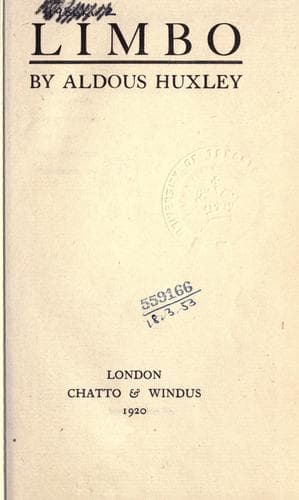
English drama -- 20th century; English fiction -- 20th century; Short stories, English
"So she was--absolutely, frozenly virginal; but she was made of a sort
of burning ice, if you understand me. She was virginally
passionate--just the combination you'd expect to find in a goddess. I
admit I was startled when she kissed me, but with infinite presence of
mind I kissed her back, on the mouth. Then the murder was finished and
the lights went on again. Nothing much more happened till the end of
the show, when I helped her on with her coat and we went out together,
as if it were the most obvious thing in the world, and got into a
taxi. I told the man to drive somewhere where we could get supper, and
he drove there."
"Not without embracements by the way?"
"No, not without certain embracements."
"Always passionately virginal?"
"Always virginally passionate."
"Proceed."
"Well, we had supper--a positively Olympian affair, nectar and
ambrosia and stolen hand-pressures. She became more and more wonderful
every moment. My God, you should have seen her eyes! The whole soul
seemed to burn in their depths, like fire under the sea----"
"For narrative," I interrupted him, "the epic or heroic style is
altogether more suitable than the lyrical."
"Well, as I say, we had supper, and after that my memory becomes a
sort of burning mist."
"Let us make haste to draw the inevitable veil. What was her name?"
Lykeham confessed that he didn't know; as she was a goddess, it didn't
really seem to matter what her earthly name was. How did he expect to
find her again? He hadn't thought of that, but knew she'd turn up
somehow. I told him he was a fool, and asked which particular goddess
he thought she was and which particular god he himself.
"We discussed that," he said. "We first thought Ares and Aphrodite;
but she wasn't my idea of Aphrodite, and I don't know that I'm very
much like Ares."
He looked pensively in the old Venetian mirror which hung over the
fireplace. It was a complacent look, for Lykeham was rather vain about
his personal appearance, which was, indeed, repulsive at first sight,
but had, when you looked again, a certain strange and fascinating ugly
beauty. Bearded, he would have made a passable Socrates. But Ares--no,
certainly he wasn't Ares.
"Perhaps you're Hephæstus," I suggested; but the idea was received
coldly.
Was he sure that she was a goddess? Mightn't she just have been a
nymph of sorts? Europa, for instance. Lykeham repudiated the implied
suggestion that he was a bull, nor would he hear of himself as a swan
or a shower of gold. It was possible, however, he thought, that he was
Apollo and she Daphne, reincarnated from her vegetable state. And
though I laughed heartily at the idea of his being Phoebus Apollo,
Lykeham stuck to the theory with increasing obstinacy. The more he
thought of it the more it seemed to him probable that his nymph, with
her burning cold virginal passion, was Daphne, while to doubt that he
himself was Apollo seemed hardly to occur to him.
* * * * *
Public-domain text, read in full here on John Shaqi.
Reviews
Reviews
No reviews yet
Be the first to share your thoughts on this work.
Elsewhere in the archive
Join the Discussion
Join the discussion
Sign in to leave a comment or review.
Sign InorCreate an account