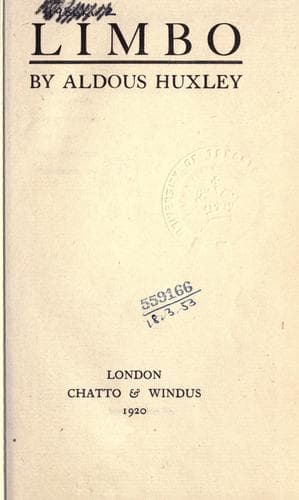
English drama -- 20th century; English fiction -- 20th century; Short stories, English
It was about a fortnight later, in June, towards the end of term, that
we discovered Lykeham's Olympian identity. We had gone, Lykeham and I,
for an after-dinner walk. We set out through the pale tranquillity of
twilight, and following the towpath up the river as far as Godstow,
halted at the inn for a glass of port and a talk with the glorious old
female Falstaff in black silk who kept it. We were royally entertained
with gossip and old wine, and after Lykeham had sung a comic song
which had reduced the old lady to a quivering jelly of hysterical
laughter, we set out once more, intending to go yet a little farther
up the river before we turned back. Darkness had fallen by this time;
the stars were lighted in the sky; it was the sort of summer night to
which Marlowe compared Helen of Troy. Over the meadows invisible
peewits wheeled and uttered their melancholy cry; the far-off thunder
of the weir bore a continuous, even burden to all the other small
noises of the night. Lykeham and I walked on in silence. We had
covered perhaps a quarter of a mile when all at once my companion
stopped and began looking fixedly westward towards Witham Hill. I
paused too, and saw that he was staring at the thin crescent of the
moon, which was preparing to set in the dark woods that crowned the
eminence.
"What are you looking at?" I asked.
But Lykeham paid no attention, only muttered something to himself.
Then suddenly he cried out, "It's she!" and started off at full gallop
across the fields in the direction of the hill. Conceiving that he had
gone suddenly mad, I followed. We crashed through the first hedge
twenty yards apart. Then came the backwater; Lykeham leapt, flopped in
three-quarters of the way across, and scrambled oozily ashore. I made
a better jump and landed among the mud and rushes of the farther bank.
Two more hedges and a ploughed field, a hedge, a road, a gate, another
field, and then we were in Witham Wood itself. It was pitch black
under the trees, and Lykeham had perforce to slacken his pace a
little. I followed him by the noise he made crashing through the
undergrowth and cursing when he hurt himself. That wood was a
nightmare, but we got through it somehow and into the open glade at
the top of the hill. Through the trees on the farther side of the
clearing shone the moon, seeming incredibly close at hand. Then,
suddenly, along the very path of the moonlight, the figure of a woman
came walking through the trees into the open. Lykeham rushed towards
her and flung himself at her feet and embraced her knees; she stooped
down and smoothed his ruffled hair. I turned and walked away; it is
not for a mere mortal to look on at the embracements of the gods.
Public-domain text, read in full here on John Shaqi.
Reviews
Reviews
No reviews yet
Be the first to share your thoughts on this work.
Elsewhere in the archive
Join the Discussion
Join the discussion
Sign in to leave a comment or review.
Sign InorCreate an account