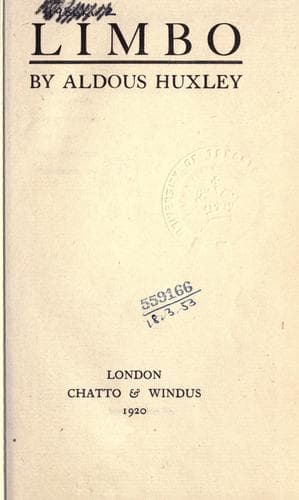
English drama -- 20th century; English fiction -- 20th century; Short stories, English
"Fit only for----" He gesticulated clutchingly with his hands as
though seeking the word.
"For the fire."
The old man was triumphantly emphatic with his, "No: for the sewer."
I laughed sympathetically at his passion. "We are delightfully at one
in our views," I told him. "May I look about me a little among your
treasures?"
Within the shop was a brown twilight, redolent with old leather and
the smell of that fine subtle dust that clings to the pages of
forgotten books, as though preservative of their secrets--like the dry
sand of Asian deserts beneath which, still incredibly intact, lie the
treasures and the rubbish of a thousand years ago. I opened the first
volume that came to my hand. It was a book of fashion-plates, tinted
elaborately by hand in magenta and purple, maroon and solferino and
puce and those melting shades of green that a yet earlier generation
had called "the sorrows of Werther." Beauties in crinolines swam with
the amplitude of pavilioned ships across the pages. Their feet were
represented as thin and flat and black, like tea-leaves shyly
protruding from under their petticoats. Their faces were egg-shaped,
sleeked round with hair of glossy black, and expressive of an
immaculate purity. I thought of our modern fashion figures, with their
heels and their arch of instep, their flattened faces and smile of
pouting invitation. It was difficult not to be a deteriorationist. I
am easily moved by symbols; there is something of a Quarles in my
nature. Lacking the philosophic mind, I prefer to see my abstractions
concretely imaged. And it occurred to me then that if I wanted an
emblem to picture the sacredness of marriage and the influence of the
home I could not do better than choose two little black feet like
tea-leaves peeping out decorously from under the hem of wide,
disguising petticoats. While heels and thoroughbred insteps should
figure--oh well, the reverse.
The current of my thoughts was turned aside by the old man's voice. "I
expect you are musical," he said.
Oh yes, I was a little; and he held out to me a bulky folio.
"Did you ever hear this?" he asked.
_Robert the Devil_: no, I never had. I did not doubt that it was a gap
in my musical education.
The old man took the book and drew up a chair from the dim
_penetralia_ of the shop. It was then that I noticed a surprising
fact: what I had, at a careless glance, taken to be a common counter I
perceived now to be a piano of a square, unfamiliar shape. The old man
sat down before it. "You must forgive any defects in its tone," he
said, turning to me. "An early Broadwood, Georgian, you know, and has
seen a deal of service in a hundred years."
He opened the lid, and the yellow keys grinned at me in the darkness
like the teeth of an ancient horse.
The old man rustled pages till he found a desired place. "The ballet
music," he said: "it's fine. Listen to this."
Public-domain text, read in full here on John Shaqi.
Reviews
Reviews
No reviews yet
Be the first to share your thoughts on this work.
Elsewhere in the archive
Join the Discussion
Join the discussion
Sign in to leave a comment or review.
Sign InorCreate an account