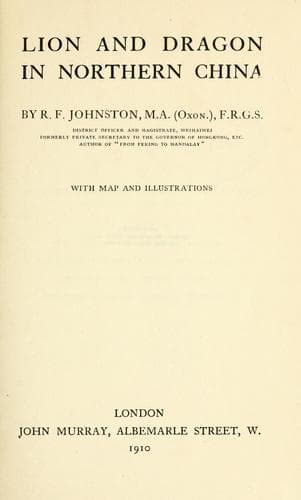
Lion and Dragon in Northern ChinaJohnston, Reginald Fleming, Sir
History
Lion and Dragon in Northern China
Johnston, Reginald Fleming, Sir
Weihai (China) -- History; Weihai (China) -- Social life and customs
And what will be the outward aspect of the China of those
days? Great industrial cities there may be; harbours thronged with
ocean-liners and with great battleships flying the Dragon flag; miles
of factories, barracks, arsenals and shipping-yards; railway trains,
motor-cars and airships coming and going incessantly from province
to province; warehouses, banks and stock-exchanges full of myriads of
buyers and sellers, each straining every nerve to excel his neighbour
in the race for wealth. And where, in this picture of China's possible
future, are the thousands of ancestral temples where to-day the members
of every family meet to do homage to their honoured dead and to renew
the bonds of kinship one with another? They are to be seen no more. In
their place stand thousands of village police-stations.
FOOTNOTES:
[65] See p. 98.
[66] _Society in China_, p. 107.
[67] _Kuei chia shih shih yang yen i ta kuan ssŭ wei lo shih._
[68] _Ta-jên._ The term _Ta Lao-yeh_ (see p. 15) is more correct for a
"father-and-mother" official, but _Ta-jên_ implies higher rank, and the
Chinese finding from experience that nearly all European officials are
foolish enough to prefer the loftier form of address, wisely make use
of it in addressing a foreigner whom they desire to propitiate.
[69] _Ta-jên tuan shih ju shên._
[70] See p. 2.
[71] See below, pp. 264 _seq._
CHAPTER VII
VILLAGE LIFE AND LAND TENURE
To enter into a detailed description of Chinese village life would
take us far astray from the immediate purpose of this book, which is
to place before the reader a picture of Weihaiwei and the manners
and customs of its people. Many such manners and customs are indeed
common to the whole Empire, and in describing them we describe China;
others are, or may be, peculiar to eastern Shantung or to the districts
in proximity to the Promontory. Indeed, the student of sociological
conditions in various parts of Asia will perhaps observe how much
there is in common, with respect to village organisation, between the
people of Weihaiwei and those--for example--of many parts of the Indian
Empire. Far apart as the races concerned are in origin, traditions, and
geographical and climatic conditions, it is yet a fact that the village
communities of Weihaiwei at the present day are, in some important
respects, identical in structure with those of Burma, especially of
Upper Burma as it was before the annexation to the British Empire.
Public-domain text, read in full here on John Shaqi.
Reviews
Reviews
No reviews yet
Be the first to share your thoughts on this work.
Elsewhere in the archive
Join the Discussion
Join the discussion
Sign in to leave a comment or review.
Sign InorCreate an account