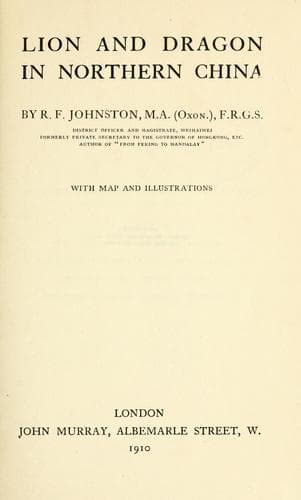
Lion and Dragon in Northern ChinaJohnston, Reginald Fleming, Sir
History
Lion and Dragon in Northern China
Johnston, Reginald Fleming, Sir
Weihai (China) -- History; Weihai (China) -- Social life and customs
From the examples given of some of the questions that come up for
decision in the courts of Weihaiwei it may be seen that in this
outlying part of the British Empire, no less than in India and the
rest of our Asiatic possessions, the chief qualifications necessary
for a judge or magistrate are not so much a knowledge of law and legal
procedure as a ready acquaintance with the language, customs, religious
ideas and ordinary mode of life of the people and an ability to
sympathise with or at least to understand their prejudices and points
of view. Perhaps no Englishman, no European or American, can hope to
administer justice or exercise executive functions among Asiatics in
a manner that will win universal approval. If he becomes too fond of
the natives he runs the risk of becoming de-occidentalised. Morally
and intellectually he becomes a Eurasian. He is distrusted by his own
countrymen, he is not respected--perhaps regarded as rather a bore--by
the natives over whom he is placed. But let the European who applies
to another the epithet of "pro-native" enquire rigorously of himself
whether his real ground of complaint is not this: that the person whom
he criticises does not in all cases support the European against the
Asiatic when the interests of the two are at variance, that he does
not necessarily accept the European point of view as the only possible
or the only just one.
"How is it that you Government officials, as soon as you have learned
the language and studied the customs of the country, become either mad
or hopelessly pro-Chinese?" This is a question which in one form or
another is frequently asked by unofficial European residents in China.
It may be that there is something in the nature of Chinese studies
that makes men mad, and indeed I have heard this soberly maintained
by persons who themselves are careful to avoid all risk of contagion.
But it never seems to occur to such questioners that there may be
some solid reasons for the apparently pro-Chinese tendencies (they
are generally only apparent) of their official friends: reasons based
on the fact that the latter have discovered--perhaps much to their
own astonishment--how much there is truly admirable and worthy of
preservation not only in Chinese art and literature and even religion,
but also in the social organisation of the Chinese people. If there is
one statement about China that can be made with perfect assurance it
is this: that if in the long process of reform she learns to despise
and throw aside all the supports she has leaned upon for thousands
of years, if she exchanges for Western substitutes all her ideals,
her philosophy of life, her ethics, her social system, she may indeed
become rich, progressive, powerful in peace and war, perhaps a terror
to the nations, but she will have left behind her very much that was
good and great, she will have parted with much that was essential to
her happiness and even to her self-respect, she will be a stranger to
herself.
Public-domain text, read in full here on John Shaqi.
Reviews
Reviews
No reviews yet
Be the first to share your thoughts on this work.
Elsewhere in the archive
Join the Discussion
Join the discussion
Sign in to leave a comment or review.
Sign InorCreate an account