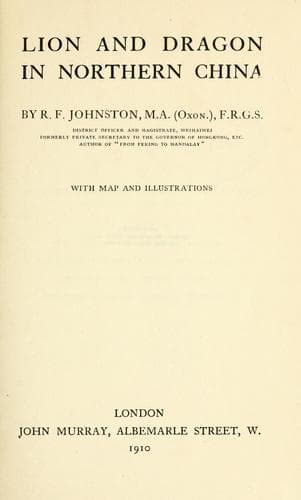
Lion and Dragon in Northern ChinaJohnston, Reginald Fleming, Sir
History
Lion and Dragon in Northern China
Johnston, Reginald Fleming, Sir
Weihai (China) -- History; Weihai (China) -- Social life and customs
The Weihaiwei Territory contains, as already stated, about three
hundred and fifteen villages and hamlets. Estimating the total area
of the Territory at three hundred square miles, and allowing for a
large hill-area of uncultivated barren land, we find that there are
probably about three villages, on an average, to every two square
miles of territory. No census has yet been taken, but the population
was long ago estimated by the military authorities (when they surveyed
the territory) at 500 to the square mile, which would give a total of
close on 150,000. I am inclined to think this estimate was too high
at the time it was made, though the present population, which has
been steadily increasing during the last decade, may not be far from
that figure. Continuing this rough estimate, it may be said that the
North Division[73] of the Territory contains 100 square miles with 84
villages, and a population of 50,000; the South Division 200 square
miles with 231 villages and a population of 100,000. There are no
walled towns or villages with the exception of the so-called city of
Weihaiwei, which is nominally under Chinese jurisdiction. There are six
market centres, all of which are situated in the South Division with
the exception of the first named: they are Weihaiwei city, Fêng-lin,
Ku-shan-hou, Ch'iao-Lou, Ts'ao-miao-tzŭ and Yang-t'ing. Market is held
at each of these places on every fifth day.
All these markets are of old standing with the exception of that of
Ku-shan-hou, which was established, or rather revived, in 1907. The
most important of the markets are those at Weihaiwei, Ch'iao-t'ou, and
Yang-t'ing. The merchandise sold includes all kinds of agricultural
produce in addition to material for clothing, cooking utensils, and
other household gear. Foreign cloth and fancy goods of a cheap kind
have a small sale. Beasts of burden are bought and sold as occasion
demands, but it is at the great annual fairs that they change hands in
largest numbers. These fairs were originally held in connection with
religious festivals, and, indeed, they are still semi-religious in
character. Men and women, especially the latter, flock to the temples,
which at other seasons are rarely visited, and burn incense before
the image of their favourite saint or deity; religious processions
are held--a great source of delight to the children, who are given
an opportunity of "dressing up"; and thousands of fire-crackers are
exploded in the temple courtyards. But it is the business aspect of the
fairs that appeals most strongly to the male adults who attend them,
for it is on these occasions that they hope to drive the best bargains
in the buying and selling of oxen, mules, ponies, donkeys and pigs.
A fair or _hui_[74] is held annually at most of the market centres
and at a few other places. One of the largest is held every spring
at T'ang-ho-hsi, close to the District Officer's headquarters, and
another at Pei-k'ou, where there is a temple in a picturesque defile.
Public-domain text, read in full here on John Shaqi.
Reviews
Reviews
No reviews yet
Be the first to share your thoughts on this work.
Elsewhere in the archive
Join the Discussion
Join the discussion
Sign in to leave a comment or review.
Sign InorCreate an account