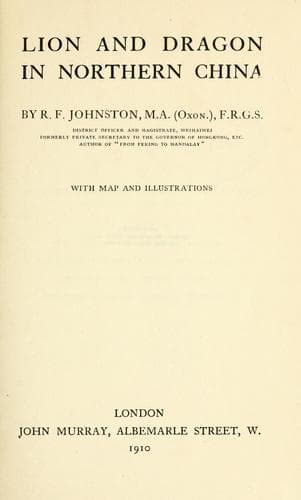
Lion and Dragon in Northern ChinaJohnston, Reginald Fleming, Sir
History
Lion and Dragon in Northern China
Johnston, Reginald Fleming, Sir
Weihai (China) -- History; Weihai (China) -- Social life and customs
Theatrical performances are always held on such occasions, in fact
they constitute part of the religious element of the _hui_. Though the
performances are secular in character they are known as _shên hsi_,
which might be translated "divine" or "religious drama."
The drama (such as it is) provides the most popular of all forms of
amusement among the agricultural classes. The actors are professionals,
who wander from place to place seeking engagements. Contracts are drawn
up by middlemen called _hsieh-hsi-ti_, and contain a concise statement
of how many days the performances are to be given (generally three or
four), how many actors are to take part in them, and what the payment
is to be. The actors carry with them their own garments, false beards,
masks and other "properties," while the stage is supplied by the
village. The stone-built theatrical pavilions usually face northwards,
towards the gateway of the temple with which they are connected.
Temples, and the images in them, face the south: thus the gods, for
whose benefit and in whose honour the plays are theoretically given,
have a full view of the entertainment. The spectators stand between the
temple and the stage. The performances (usually consisting of short
separate plays) take place at intervals throughout the whole of each
day.
[Illustration: A TYPICAL THEATRICAL STAGE BELONGING TO A TEMPLE
(see p. 130).]
[Illustration: VILLAGE THEATRICALS (see p. 132).]
There is very little originality in the plots of the pieces presented;
they are all taken from or founded on well-known Chinese legendary
episodes or on events described in famous historical novels. If this
were not the case, the dramatic methods in vogue in agricultural China
would have to be modified; for the dialogue cannot under present
conditions be heard distinctly except by a limited number of the
audience. Not to mention the gongs and cymbals of the orchestra, which
frequently come into action at what appears to foreigners to be the
wrong moment, the open air soon dissipates the players' voices, and the
great body of spectators ("audience" is hardly an appropriate word) is
apt to be somewhat restless, if not noisy. Female parts are generally
taken by specially trained boys or young men, though actresses are no
longer unknown in China. The acting is rarely good from a European
point of view; on the contrary, it is very stiff and full of what
seem to us ridiculous mannerisms. But it is unfair to judge of the
histrionic art of China from what one sees at a country fair.
Public-domain text, read in full here on John Shaqi.
Reviews
Reviews
No reviews yet
Be the first to share your thoughts on this work.
Elsewhere in the archive
Join the Discussion
Join the discussion
Sign in to leave a comment or review.
Sign InorCreate an account