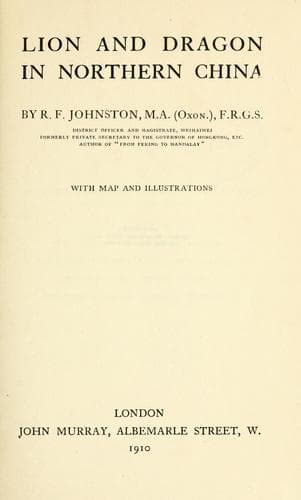
Lion and Dragon in Northern ChinaJohnston, Reginald Fleming, Sir
History
Lion and Dragon in Northern China
Johnston, Reginald Fleming, Sir
Weihai (China) -- History; Weihai (China) -- Social life and customs
The frequent association of the drama with religion in China will
naturally recall to the minds of students of English literature
the miracle-plays and mysteries of the Middle Ages in Europe. But
the analogy is not a very close one. The English drama, regarded
historically, may be said to be English through and through. The
changes it underwent were almost, if not quite, independent of the
history of the drama on the Continent. The evolution of the drama
can be traced step by step from its origin to its culmination in the
hands of the great Elizabethans. In China the origin of the drama is
doubtful; it is not (in its present or any similar form) of great
antiquity, and dramatic writing has never taken rank as a very high
form of art. Some of the elements of drama may probably be traced
in the stately gesture-dances, combined with music, of which we
read in some of the oldest Chinese books. Dances which are probably
very similar to those performed at the courts of the ruling dukes
in Confucius's time may be witnessed at the present day in parts of
Further India. In the old Indo-Chinese capital of Vientian on the
Mekong (now the capital of French Laos) I witnessed, in 1902, a dance
of this kind. By a stretch of the imagination it might have been styled
a drama in dumb show, but with more dumb show than drama: a dance that
aimed at expressing not so much the poetry of graceful movement as the
poetry of successive states of more or less dignified repose.
The Chinese drama of to-day is still a drama of posturing and gesture:
the player is for ever aiming at "striking an attitude." This is all
the more remarkable among a people who in ordinary life consider
gesture undignified and indicative of a lack of self-control. It
can, I think, be explained only as a survival from the days when
the Chinese drama consisted mainly of dance and music. The literary
developments of the drama--if indeed they may correctly be described
as developments--date only from the time of the Yüan dynasty
(1280-1367), and the popularity of the drama among the people seems to
have been only of gradual growth since that date. It was apparently
an importation from Central Asia, and came to China with the Mongol
conquerors. For some time this novel form of art was confined to
Peking and the other great centres of Mongol power, and to this day
the influence of Peking is shown in the very frequent employment of
the Peking dialect even in provinces where that form of speech is
unintelligible to the mass of the people.
Public-domain text, read in full here on John Shaqi.
Reviews
Reviews
No reviews yet
Be the first to share your thoughts on this work.
Elsewhere in the archive
Join the Discussion
Join the discussion
Sign in to leave a comment or review.
Sign InorCreate an account