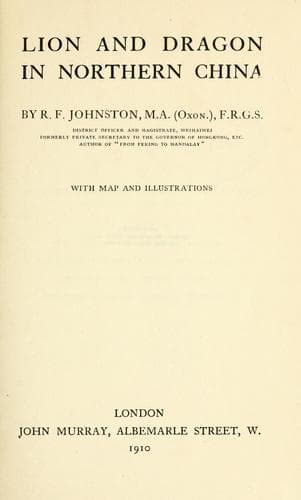
Lion and Dragon in Northern ChinaJohnston, Reginald Fleming, Sir
History
Lion and Dragon in Northern China
Johnston, Reginald Fleming, Sir
Weihai (China) -- History; Weihai (China) -- Social life and customs
The reason why Ku brought his case to my court was not that he objected
to this unexpected call upon his slender purse, for as it happened he
had already paid the whole amount without a murmur; he merely came to
suggest that as the original debtor had two direct living descendants
besides himself, those two persons should be required to pay their fair
shares of the ancestral debt. He wished to know the views of the court
on the point before he demanded payment from them. The man might in law
have repudiated this debt altogether: Chinese law does not and could
not go as far as local custom in settling questions that directly or
indirectly concern the honour of a family. Repudiation of an ancestor's
debt is, however, as rare in a Weihaiwei village as is bankruptcy.
Debts may go unpaid, but only at the risk of a "loss of face" that
would in most cases cause the debtor much greater inconvenience and
discomfort than the monetary loss.
Weihaiwei has as yet shown but little tendency to modify its
semi-patriarchal social system as a consequence of its fifteen years
of continuous contact with Western civilisation. The individual is
still sunk in the family. He cannot divest himself of the rights any
more than of the responsibilities that belong to him through his family
membership. The Weihaiwei farmer has indeed so limited a conception
of his own existence as a separate and distinct personality that in
ordinary speech he continually confuses himself with his ancestors or
with living members of his family. Examples of this are of repeated
occurrence in the law-courts. "I bought this land and now the Tung
family is trying to steal it from me," complains a petitioner. "When
did you buy it?" asks the magistrate. "Two hundred years ago," promptly
replies the oppressed one. Says another, "My rights to the property
of Sung Lien-têng are being contested by my distant cousin. I am
the rightful owner. I buried Sung Lien-têng and have charge of his
soul-tablet and carry out the ancestral ceremonies." "When did Sung
Lien-têng die?" questions the magistrate. "In the fortieth year of
K'ang Hsi" is the reply. This means that the deceased whose property is
in dispute died childless in 1701, that plaintiff's ancestor in that
year defrayed the funeral expenses and acted as chief mourner, that by
family agreement he was installed as adopted son to the deceased and
heir to his property, and that plaintiff claims to be the adopted son's
descendant and heir. Looking upon his family, dead and alive, as one
and indivisible, he could not see any practical difference between the
statement that certain funeral rites had been carried out by himself
and the statement that they had been carried out by a direct ancestor.
Public-domain text, read in full here on John Shaqi.
Reviews
Reviews
No reviews yet
Be the first to share your thoughts on this work.
Elsewhere in the archive
Join the Discussion
Join the discussion
Sign in to leave a comment or review.
Sign InorCreate an account