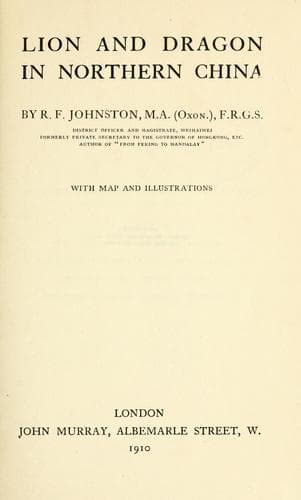
Lion and Dragon in Northern ChinaJohnston, Reginald Fleming, Sir
History
Lion and Dragon in Northern China
Johnston, Reginald Fleming, Sir
Weihai (China) -- History; Weihai (China) -- Social life and customs
Another litigant, whose long residence abroad had had no apparent
effect on his general outlook on life, came to me very recently with
the complaint that on his return from Manchuria he had found his land
in the possession of a neighbour. "I went to Manchuria as my family
had not enough to eat," he said. "I came home this year and wished to
redeem the land I had mortgaged before I went away. But I found it had
been already redeemed by my neighbour, a cousin, and he refuses to let
me redeem it from him." On being asked when he had mortgaged his land
and emigrated, he replied: "In Chia Ch'ing 3"--that is, in 1798. He was
merely identifying himself with his own great-grandfather.
In another case a man whom I will call A brought a plaint to the effect
that he wished to adopt B, and that C for various reasons refused to
allow this adoption to take place. On investigation it turns out that
B is dead and that it is his infant son D whom A really wishes to
adopt. B and D--father and son--seem to A merely different expressions,
as it were, of the same entity. This does not mean, of course, that
supposing B were still alive it would not matter whether B or D
actually became A's adopted son. The rules of adoption in China are
strictly regulated. A man cannot adopt any one he likes. Not to mention
other necessary conditions, the person adopted must belong to the
appropriate generation, that is, to the generation immediately junior
to that of the adopter. In the case before us the infant D belonged to
the proper generation, and his father B could not have been adopted. To
our notions it seems all the stranger that A, knowing this, should have
spoken of B when he meant D: yet this manner of speech is exceedingly
common.
But after all, if we wish to assure ourselves that the individual is
not regarded as an independent unit we must rely on stronger evidence
than strange verbal inaccuracies. Perhaps the best and most convincing
proofs will be found in the restrictions placed on the powers of the
individual to dispose of real property.
Public-domain text, read in full here on John Shaqi.
Reviews
Reviews
No reviews yet
Be the first to share your thoughts on this work.
Elsewhere in the archive
Join the Discussion
Join the discussion
Sign in to leave a comment or review.
Sign InorCreate an account