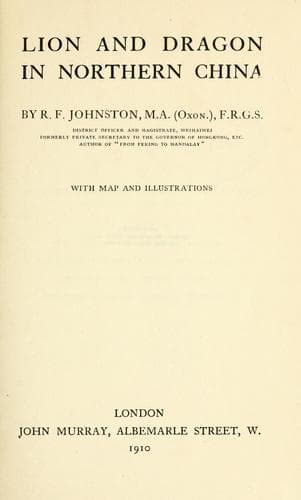
Lion and Dragon in Northern ChinaJohnston, Reginald Fleming, Sir
History
Lion and Dragon in Northern China
Johnston, Reginald Fleming, Sir
Weihai (China) -- History; Weihai (China) -- Social life and customs
Be it remembered, moreover, that "family" does not imply merely a
father and a mother with their children. It includes also nephews,
grand-nephews, cousins of several degrees, and in fact all who come
within the description of _wu fu_, or persons on whose decease one must
assume one of the five degrees of "mourning." In England, if a man's
title-deeds are in order, and the land is free from encumbrances, no
one will question his perfect right, as an independent individual, to
sell his land how and to whom he chooses. It is unnecessary for him to
consult relations, neighbours or friends. Now in Weihaiwei, which is
a typical Chinese agricultural district, the man who tried to dispose
of his landed property without fully discussing the whole matter with
all the prominent members and "elders" of his village--or rather with
those among them who are of the same surname and come within the _wu
fu_--would find himself foiled at the outset, for no one would venture
to run the risk of buying land that was being offered for sale in so
peculiar and irregular a manner. Even if the purchaser, being a man
of wealth and influence, were prepared to run all possible risks,
who would be found to draw up the deed of sale? Who would take the
place of the numerous relatives who always append their signatures to
such documents as proof that all is in order? The would-be seller's
title-deeds may be in perfect order; the land may have come down to
him from his direct ancestors and his right to sell may be apparently
incontestable. But he is not the less bound to satisfy his uncles and
brothers and cousins, as well as his own sons, as to the reason for his
desire to sell, and even if they agree that a sale is necessary (owing
perhaps to the seller's debts) he is by no means permitted to dispose
of the property by public auction or offer it to the highest bidder.
All his relatives, more or less in the order of their seniority or
proximity, must be given the option of purchase, and if the price
offered by an influential relative is considered fair by the general
voice of the village or the clan, he must perforce accept it and be
thankful or refrain from selling his land. The theory that seems to
lie at the root of this custom is not that the land is the common
property of the clan but that the individual _per se_ is only the limb
of a body, and cannot therefore act except in accordance with the will
of the organism to which he belongs; and that it is contrary to the
interests of the family that a portion of the real property belonging
to any of its members should pass into alien hands.
Public-domain text, read in full here on John Shaqi.
Reviews
Reviews
No reviews yet
Be the first to share your thoughts on this work.
Elsewhere in the archive
Join the Discussion
Join the discussion
Sign in to leave a comment or review.
Sign InorCreate an account