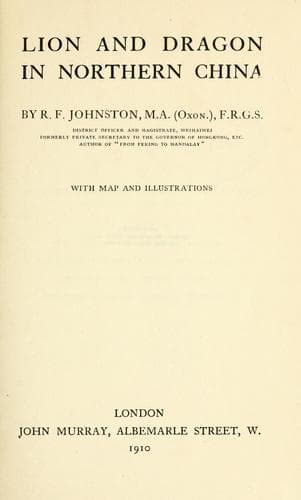
Lion and Dragon in Northern ChinaJohnston, Reginald Fleming, Sir
History
Lion and Dragon in Northern China
Johnston, Reginald Fleming, Sir
Weihai (China) -- History; Weihai (China) -- Social life and customs
Absolute sales of land are, indeed, not regarded with favour even if
conducted according to the "rules." They have grown common in Weihaiwei
during the past few years, partly because the great increase in the
value of agricultural land has tempted many to take advantage of a
condition of the real-estate market which they think may only be
temporary; partly because foreign occupation and other recent events
have opened out new avenues of employment to large numbers of the
people who are willing, therefore, to dispose of the little plots of
land that are no longer their all-in-all; partly because many of the
smaller land-holders are engaging in commerce or emigrating to Chihli
and to Manchuria. For these and other reasons a good deal of land has
changed and is changing hands, but the old custom whereby real property
can be transferred only from relative to relative is still observed
with very slight if any relaxation of its former strictness.
A Chinese deed of sale, carefully examined, throws an interesting light
on the systems of land-tenure and the conditions under which transfer
is permissible. Without going into technical details, which would be
of small interest to the general reader, attention may be drawn to
the fact that the reason why the seller is disposing of his land must
always be stated. The theory seems to be that he should not want to
sell his land, and that his desire to do so is highly regrettable if
not reprehensible. The document therefore sets forth in detail that
(for example) "Ch'i Tê-jang of Ch'i-chia-chuang, _being altogether
without_ _money or means of subsistence_, is obliged to sell that
piece of land measuring ... _mu_ in extent, bounded as follows: ..., to
his younger "brother" of the same generation [really a cousin] named
Ch'i Shuan, to be held by him as his absolute property for ever."
To these clauses are appended any reservations or special provisions
by which the purchaser is to be bound, and the deed closes with the
statement that it is drawn up "in case hereafter there should be no
proof of the transaction." Then follow the names and crosses of the
witnesses, all of whom are members of the "family,"[86] the name of the
writer of the deed, who is often a schoolmaster, and the name of the
village headman, who is generally himself a relative. The witnesses,
it will now be understood, are very far from being merely persons
invited to testify to the execution of a deed. They have themselves
been consulted at every step of the negotiations, it is they by whom
the purchase price has probably been fixed, and their consent has been
necessary before the deed could be drawn up or the land sold.
Public-domain text, read in full here on John Shaqi.
Reviews
Reviews
No reviews yet
Be the first to share your thoughts on this work.
Elsewhere in the archive
Join the Discussion
Join the discussion
Sign in to leave a comment or review.
Sign InorCreate an account