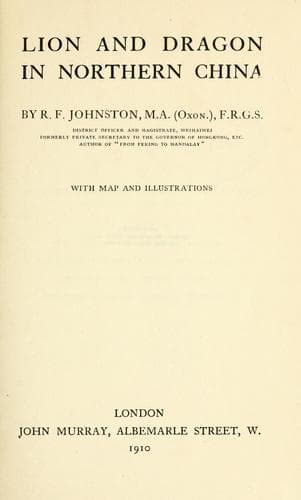
Lion and Dragon in Northern ChinaJohnston, Reginald Fleming, Sir
History
Lion and Dragon in Northern China
Johnston, Reginald Fleming, Sir
Weihai (China) -- History; Weihai (China) -- Social life and customs
Perhaps several years later B returns from Manchuria. He has money and
wishes to redeem his land. He soon discovers that it has been redeemed
by his brother A. His own rights of redemption, however, are still
valid; he applies to A for the return of the land for the same price at
which it was originally mortgaged to C. A must comply. If B has been
absent many years and meanwhile the land has greatly risen in value,
A will probably give it up with a very bad grace. If the original
mortgage-deed was badly drawn up or there are some doubts about what
actually took place, A will perhaps refuse to surrender the land at
all unless or until he is ordered to do so by the court. Litigation
concerning transactions of this kind has been common in Weihaiwei of
recent years. A man who mortgaged his land many years ago, perhaps at
a time of famine and scarcity, for a ridiculously small sum, returns
from abroad to find his land worth five or more times what it was
worth then. He is naturally eager to redeem it, while the person in
whose hands it now is--whether the original mortgagee or one of the
mortgagor's family--is equally eager to retain it. The court in such
cases naturally supports local custom, though there are sometimes
bewildering complications which render it no easy matter to give a
rigidly just decision. Deeds of sale and mortgage of real property
used to be drawn up in an excessively vague and slipshod manner--the
very boundaries of the land being either not mentioned at all or
inaccurately; moreover nearly all such deeds were "white" deeds--that
is to say they had not been put through the formal process of
registration which would turn them into legal documents. To remedy this
state of things (which was not to be wondered at in a district where
ignorant peasants do their own conveyancing without legal assistance)
certain recommendations were made some years ago which resulted
in the adoption of a new system whereby all intending sellers and
mortgagors of land are obliged to use an officially-stamped deed-form,
on which spaces are provided for the proper description of land-areas
and other necessary particulars. The forms are numbered and kept in
counterfoil-books, and no deed can evade registration except through
the negligence of Government clerks. Government has in this simple
procedure a small but unfailing source of revenue, the magistrates find
their labours in the court simplified, and the people are greatly
benefited by having more satisfactory title-deeds to their lands (or
rather proofs of legal purchase and mortgage) than they ever had before.
Public-domain text, read in full here on John Shaqi.
Reviews
Reviews
No reviews yet
Be the first to share your thoughts on this work.
Elsewhere in the archive
Join the Discussion
Join the discussion
Sign in to leave a comment or review.
Sign InorCreate an account