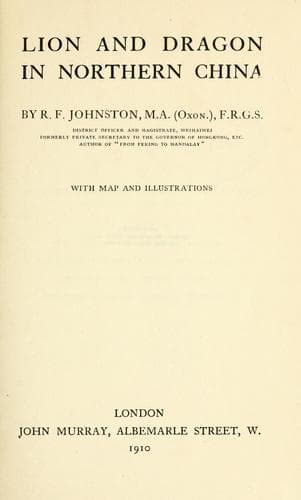
Lion and Dragon in Northern ChinaJohnston, Reginald Fleming, Sir
History
Lion and Dragon in Northern China
Johnston, Reginald Fleming, Sir
Weihai (China) -- History; Weihai (China) -- Social life and customs
Mortgages in Weihaiwei, as probably in the rest of China, are much
commoner than sales. A farmer will generally sell his land only because
he must; he will mortgage it on very slender provocation. As a mortgage
does not definitely alienate the land from the family, the customary
rules regulating this transaction are much more flexible than those
relating to sales. Sometimes a piece of land is merely mortgaged as
security for a temporary loan, in which case the mortgagor remains
on the land;[87] in other cases it is mortgaged because the owner is
going abroad or because the opposition on the part of the family to a
definite sale is too strong to be overcome. In such cases the rights of
cultivation are transferred to the mortgagee. In the great majority of
cases mortgaged lands are subsequently redeemed.[88]
Some of the customs regarding redemption are rather curious, and
strongly emphasise the theory that redemption is a duty which must
be undertaken by another member of the family if the original
mortgagor will not or cannot do it himself. For example, A and B are
two brothers. They _fên chia_, that is to say they set up separate
establishments, each taking his own share of the family property. A
remains at home, quietly cultivating his farm, while B decides to
emigrate to Manchuria. In order to raise some necessary capital he
decides to mortgage his share of the family land; but as neither A
nor any other relative can provide the amount of money he requires,
he is obliged to mortgage his property to an outsider C--a man of
different surname who lives in a neighbouring village. This man C
takes possession of the land as mortgagee and cultivates it for some
years. B meanwhile is in Manchuria, and no one knows how he is faring,
or whether he is alive or dead. A now goes to C and tells him that he
wishes to redeem the land mortgaged to B. It is obvious that according
to strict legality the land should only be redeemed by the original
mortgagor. B's name alone is on the deed: A had nothing whatever to do
with the transaction. Yet, by custom, C must resign the land to A; not
merely because A produces the mortgage-price, but because he is one of
B's family.
Public-domain text, read in full here on John Shaqi.
Reviews
Reviews
No reviews yet
Be the first to share your thoughts on this work.
Elsewhere in the archive
Join the Discussion
Join the discussion
Sign in to leave a comment or review.
Sign InorCreate an account