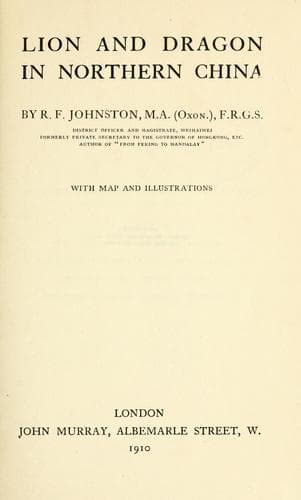
Lion and Dragon in Northern ChinaJohnston, Reginald Fleming, Sir
History
Lion and Dragon in Northern China
Johnston, Reginald Fleming, Sir
Weihai (China) -- History; Weihai (China) -- Social life and customs
As a father cannot, except in exceptional circumstances, deprive
his son of the family inheritance, it follows that a man's power of
making a will is severely limited. The division of property between
brothers may take place either after their father's death or while he
is still living. The process is called _fên chia_,--Division of the
Family. When brothers _fên-chia_ it means in general terms that each
takes his share of the family inheritance and leaves the paternal
roof: and the document which is drawn up to define and give effect
to the agreement is known as a _fên-shu_ or written statement of the
details of division.[90] The share of each participating member of the
family is clearly stated in the _fên-shu_, and each is given a copy of
the document to hold henceforth as his title-deed. A _fên-shu_ is in
Weihaiwei generally drawn up by mutual agreement between brothers after
their father's death. If the arrangement is made during the father's
(or mother's) lifetime, a portion of the property usually remains in
the parent's hands as _yang-lao-ti_--"Nourish-old-age land." After his
or her death the _yang-lao-ti_ is made to bear the cost of the funeral,
and what remains is divided up among the heirs. A portion of the
property is sometimes set aside as _chi t'ien_ (sacrificial land) to be
cultivated in turn by all the brothers participating in the division.
Sometimes the father keeps no _yang-lao-ti_ for himself but merely
stipulates either that he shall be supported by all his sons in turn
or shall receive from them a fixed proportion of the produce of their
several shares. The former of these arrangements works very well when
the members of the family are in complete harmony with one another;
but sometimes a discordant note is struck either by an unfilial son
or (much more often) by one of the sons' wives, who perhaps fails to
treat her husband's father with proper respect.[91] A woman in China,
be it remembered, practically severs her connection with her own family
when she marries; her husband's parents are henceforth regarded as
her own, and she owes them just the same obedience and filial respect
that are owed them by her husband. The _patria potestas_, in fact, is
exerted not only over sons and grandsons but also over their wives.
But in practice we find that sons' wives do not always, to put it
mildly, show the meek and reverential obedience to their _kung-tieh_,
or father-in-law, that Chinese law enjoins and public opinion considers
desirable.
Public-domain text, read in full here on John Shaqi.
Reviews
Reviews
No reviews yet
Be the first to share your thoughts on this work.
Elsewhere in the archive
Join the Discussion
Join the discussion
Sign in to leave a comment or review.
Sign InorCreate an account