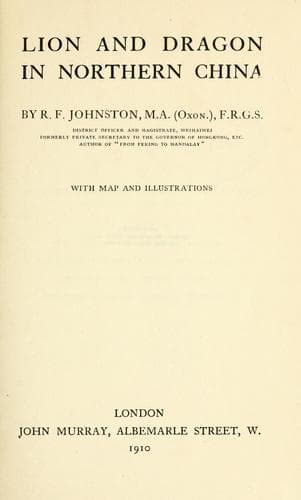
Lion and Dragon in Northern ChinaJohnston, Reginald Fleming, Sir
History
Lion and Dragon in Northern China
Johnston, Reginald Fleming, Sir
Weihai (China) -- History; Weihai (China) -- Social life and customs
As the mother, no less than the father of a family, is made the object
of ancestral "worship," it follows that she succeeds, nominally if
not always actually, to her deceased husband's control over the
family property. A widow is regarded as possessing a life-interest
in her husband's lands, subject of course to the rights, actual or
potential, of her sons. If the _fên-chia_ has already taken place,
all she can personally control is her _yang-lao-ti_. If, however, she
enters into a second marriage, she must relinquish all her rights
in her first husband's property. The reason of this is obvious. If
widows were allowed to endow their second husbands with the property
of the first, there would be a gradual disintegration of the system of
family-ownership. There would no longer be any guarantee that the land
would follow the "name."
If the "family-division" or _fên-chia_ does not take place till after
the father's death but during the lifetime of the mother, the deed
of division or _fên-shu_ must make reference to the fact that the
transaction has received the mother's authorisation. The following may
be taken as a very ordinary type of _fên-shu_ in Weihaiwei:
"This _fên-shu_ is made under the authority of Yü Ts'ung Shih.[92]
There are three sons, of whom the second, Shu-yen, has been
'adopted out' to another branch of the family.[93] The following
division of property is made between the eldest son Shu-tung and
the third son Shu-shan. The division is necessary because the
families of Shu-tung and Shu-shan have become so large that it
is no longer convenient for them all to live together. With the
knowledge and assent of their relatives they have drawn lots
for the division of the property, and the result is as follows:
Shu-tung's share is the plot of land ...; Shu-shan's share is the
family house, consisting of the three-roomed central building and
two side-buildings of two rooms each, together with the garden and
fields bounded.... This deed is made out in duplicate, in order
that Shu-tung and Shu-shan may each possess an original and hold
it as his just title to the property allotted to him. This deed
is drawn up and attested by the clan-members so that none of the
parties concerned may hereafter go back on the division of property
herein described. If any one raises any complaint hereafter,
let him be sent to the magistrate in order that he may receive
punishment for the crime of want of filial piety (_pu hsiao_)."
Then follow the names of a number of attesting and assenting relatives,
the name of the writer of the deed, and the date. Simultaneously a
second deed, called a _ch'u tan_ or Reservation of _Yang-lao-ti_, is
very often drawn up in such terms as these:
Public-domain text, read in full here on John Shaqi.
Reviews
Reviews
No reviews yet
Be the first to share your thoughts on this work.
Elsewhere in the archive
Join the Discussion
Join the discussion
Sign in to leave a comment or review.
Sign InorCreate an account