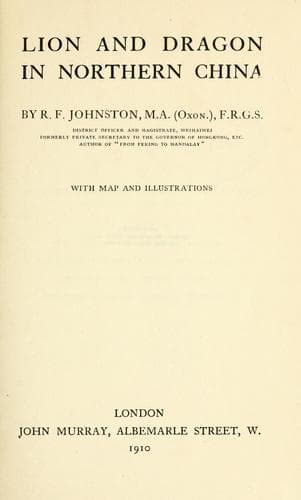
Lion and Dragon in Northern ChinaJohnston, Reginald Fleming, Sir
History
Lion and Dragon in Northern China
Johnston, Reginald Fleming, Sir
Weihai (China) -- History; Weihai (China) -- Social life and customs
[80] The family-system has of course existed in regions other than
Asia. "In most of the Greek states and in Rome," says Sir Henry Maine
(_Ancient Law_, 4th ed., p. 128), "there long remained the vestiges
of an ascending series of groups out of which the State was at first
constituted.... The elementary group is the Family, connected by common
subjection to the highest male ascendant. The aggregation of Families
forms the Gens or House. The aggregation of Houses makes the Tribe.
The aggregation of Tribes constitutes the commonwealth." In another
place (p. 126) he speaks of "the clearest indications that society
in primitive times was not what it is assumed to be at present, a
collection of _individuals_. In fact, and in the view of the men who
composed it, it was _an aggregation of families_. The contrast may be
most forcibly expressed by saying that the _unit_ of an ancient society
was the Family, of a modern society the individual." Had Maine been
acquainted with the details of the social organisation of the Chinese
he would have found a copious source from which to draw illustrations
of his thesis, and would have perceived that the family-unit system is
not yet to be spoken of as a vanished phase of social development.
[81] "The whole Chinese administrative system is based on the doctrine
of filial piety, in its most extended signification of duty to natural
parents and also to political parents, as the Emperor's magistrates
are to this day familiarly called. China is thus one vast republic
of innumerable private families, or petty _imperia_, within one
public family, or general _imperium_; the organisation consists of a
number of self-producing and ever-multiplying independent cells, each
maintaining a complete administrative existence apart from the central
power. Doubtless, it is this fact which in a large measure accounts
for China's indestructibility in the face of so many conquests and
revolutions."--PROF. E. H. PARKER in the _Journal of the Royal Asiatic
Society (China Branch)_, vol. xl. (1909), p. 14.
[82] It must be understood that what is referred to is "custom" rather
than law, and that these remarks are not always applicable to the
business relations between Chinese and foreigners at the treaty-ports,
where commercial intercourse is to a great extent conducted on Western
lines. When an English banker declares (as he has declared) that the
word of a Chinese is as good as his bond, he is paying a compliment not
so much to the character of the Chinese people (who as individuals are
no more though perhaps no less trustworthy than average Englishmen),
as to the fundamental soundness of the Chinese social system. If that
system is subverted, through the efforts either of foreign advisers
or of Chinese reformers, the moral results may be disastrous beyond
conception. Let there be evolution by all means; not revolution.
[83] As, for instance, after the silk worms have been taken off the
scrub-oak bushes.
Public-domain text, read in full here on John Shaqi.
Reviews
Reviews
No reviews yet
Be the first to share your thoughts on this work.
Elsewhere in the archive
Join the Discussion
Join the discussion
Sign in to leave a comment or review.
Sign InorCreate an account