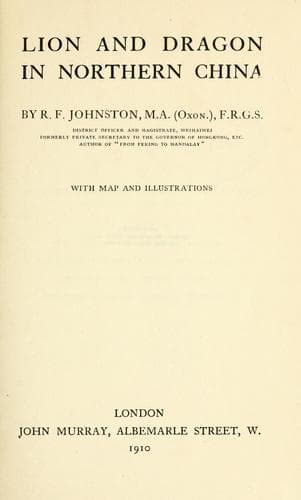
Lion and Dragon in Northern ChinaJohnston, Reginald Fleming, Sir
History
Lion and Dragon in Northern China
Johnston, Reginald Fleming, Sir
Weihai (China) -- History; Weihai (China) -- Social life and customs
If as a result of repeated subdivisions the family property has become
so small that there is not enough to "go round," or the family is so
large that an equal division would leave each with too little for
his support, the usual arrangement is for the entire property to be
mortgaged or sold to the nearest relatives who are willing to buy. The
cash proceeds are then divided equally among the brothers, who separate
to seek their fortunes, each according to his bent. One may emigrate
to Manchuria, or join his numerous fellow-provincials in the capital,
another may set up a shop in the neighbouring market-village, a third
may wander off to one of the great commercial ports on the coast, and
seek employment under foreigners. The unsuccessful ones may possibly
never be heard of again; the successful ones will probably return after
many days to their native village and re-purchase or redeem the old
family property.
The remarkable increase in the value of agricultural land that has
taken place in the Weihaiwei Territory during the past few years is a
pleasant symptom of the advancing prosperity of the people. The fact
must be admitted, however, that the increase is to a considerable
extent due to their economic backwardness. There is a serious want of
local means for the satisfactory investment of capital. To purchase
land is to the great mass of the population the only safe way in which
savings or profits can be employed. The consequence is that the land
has now acquired a somewhat fictitious value, a fact which may come
prominently into view if the people should be visited by some calamity
such as a succession of bad harvests.
FOOTNOTES:
[72] See pp. 262 _seq._
[73] See pp. 97-8.
[74] The word may be translated as "a coming together." It is the usual
word for a "society" or "club."
[75] _Chia miao._
[76] _Shên chu._
[77] _Huo Ying-ti._
[78] _Chi-t'ien._
[79] As an indication of how widely sundered are the theory and
practice of East and West in the matter of social organisation, D. G.
Ritchie's _Natural Rights_ (1903 ed.), pp. 259-60, may be consulted.
"No real or positive equality in social conditions," says that writer,
"can be secured so long as individuals are looked at in any respect as
members of families, and not in every respect as members of the State
alone." Yet in China, where individuals are in almost every respect
regarded as members of families, and never dream of claiming to be
members of the State alone, there is far greater equality in social
conditions than there is in the individualistic States of the West! Let
us hope for China's sake that this fact will not be overlooked by those
young patriot-reformers who are casting about for ways and means of
raising their country in the scale of nations.
Public-domain text, read in full here on John Shaqi.
Reviews
Reviews
No reviews yet
Be the first to share your thoughts on this work.
Elsewhere in the archive
Join the Discussion
Join the discussion
Sign in to leave a comment or review.
Sign InorCreate an account