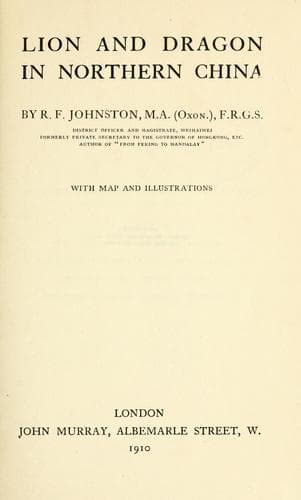
Lion and Dragon in Northern ChinaJohnston, Reginald Fleming, Sir
History
Lion and Dragon in Northern China
Johnston, Reginald Fleming, Sir
Weihai (China) -- History; Weihai (China) -- Social life and customs
The villages of Weihaiwei, so far as their domestic affairs are
concerned, are somewhat like so many little self-contained republics,
each with its own ancestral temple, its _t'u-ti miao_[96] or temple of
the local tutelary spirit, its theatre, its pasture-lands, its by-laws,
its graveyard, and its little band of elders under the leadership of
the headman. There is no regular village council. The "elders" are
simply the most influential or most respected of the inhabitants, and
their number is elastic. When important matters arise, affecting the
interests of the whole village, they discuss them in the headman's
house, or in a temple, or in the village street under the shade of an
old tree. Nothing is discussed with closed doors. The whole village,
including the women and children, may as a rule attend a meeting of
elders, and any one who wishes to air his views may do so, irrespective
of his age or position in the village. The elders have few privileges
that their fellow-villagers do not share, and the headman himself is
only _primus inter pares_. His authority, like that of the elders, is
chiefly derived from his position as head of the family or clan.
When all the people are bound together by ties of blood relationship,
as is the case in a typical Weihaiwei village, the bonds of family
life and the bonds of village life are one and the same. The senior
representative of the senior branch of the family holds as a rule a
double responsibility: as the head of the family he is the natural
arbitrator or judge in cases of domestic strife or petty crime, and as
headman of the village he is held, to a limited extent, responsible by
Government for the good conduct of his fellow-villagers. It is true
that in practice the headman is not always the senior representative
of the senior branch of the family. Under British rule, indeed, every
new headman is "confirmed" by Government and receives a _chih-chao_, or
official certificate of appointment. This applies both to the District
headmen[97] and to the headmen of villages. But in both theory and
practice the headman is the chosen of the people. He may fall into the
position with their tacit consent by virtue of the _patria potestas_,
or in consequence of his wealth, strong personality or social prestige;
or he may be definitely elected after a consultation among the heads of
families.
Public-domain text, read in full here on John Shaqi.
Reviews
Reviews
No reviews yet
Be the first to share your thoughts on this work.
Elsewhere in the archive
Join the Discussion
Join the discussion
Sign in to leave a comment or review.
Sign InorCreate an account