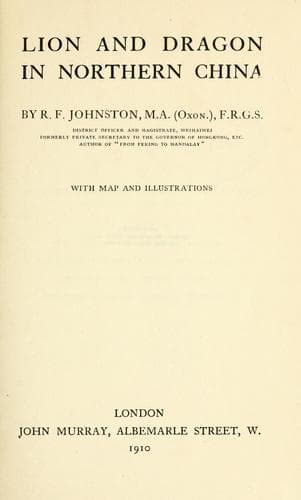
Lion and Dragon in Northern ChinaJohnston, Reginald Fleming, Sir
History
Lion and Dragon in Northern China
Johnston, Reginald Fleming, Sir
Weihai (China) -- History; Weihai (China) -- Social life and customs
The position of headman is not altogether enviable, and there is little
or no competition for the filling of a vacancy. Sometimes, indeed,
it is only after a village has been threatened with a general fine
that it will make the necessary recommendation. This is especially
the case since the establishment of British rule, for Government
shows--or did show--a tendency in Weihaiwei to increase the headman's
responsibilities without giving him any compensating advantages.[98]
The headman, as such, has no very definite authority over the
individuals of his village, but every individual is bound by rigid
unwritten law to conform to the will of the _maior et sanior pars_,
and to fulfil his duties to the community even if they involve his own
discomfort.
It is true that the Chinese village cannot be said to possess
corporate unity. Even in Europe the evolution of the "juristic person"
was a slow process, and it is not likely that we shall find the
developed principles of corporate existence amid the heterogeneous
elements of village life in China, where there are no professional
lawyers to interpret indefinite social facts by the light of definite
legal fictions. Yet the germs of the theory of a _persona ficta_ may
perhaps be found in several features of the village-system. Most
villages, for instance, possess funds which are collected and disbursed
for the benefit or amusement of the inhabitants collectively; and
we usually find in the typical village a strongly-developed sense
of mutual responsibility and a general acceptance of the obligation
to co-operate for common ends. A man was once accused before me
of refusing to join his fellow-villagers in subscribing towards
the expenses of the local _hui_ with its inevitable theatrical
performances. He admitted in court that he was in the wrong and
undertook to contribute his proper share forthwith. Had this man been a
Christian the matter would not have been so easily disposed of. It is
well known that troubles have arisen in various parts of China through
the refusal of Christian converts to subscribe towards their village
entertainments on the ground that such entertainments were idolatrous
or involved the performance of pagan ceremonies. When one understands a
little of the Chinese village organisation one can see, perhaps, that
there is something to be said on the side of the indignant "pagans,"
and that the trouble has not necessarily arisen from their hostility to
the religious views, as such, of their converted fellow-villagers. It
is obvious that the solidarity of the village system would be severely
shaken if individuals were allowed to dissociate themselves at will
from the actions of the village as a whole.
Public-domain text, read in full here on John Shaqi.
Reviews
Reviews
No reviews yet
Be the first to share your thoughts on this work.
Elsewhere in the archive
Join the Discussion
Join the discussion
Sign in to leave a comment or review.
Sign InorCreate an account