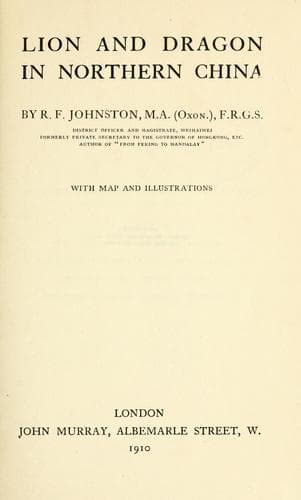
Lion and Dragon in Northern ChinaJohnston, Reginald Fleming, Sir
History
Lion and Dragon in Northern China
Johnston, Reginald Fleming, Sir
Weihai (China) -- History; Weihai (China) -- Social life and customs
The peace of an ordinary Weihaiwei village is not often seriously
disturbed. The chief causes of trouble are bad-tempered women, who
form an appreciable proportion of the population. Robbers and other
law-breakers are few in number; not necessarily because the Chinese
are by nature more honest and respectable than other people, but
because the social system to which they belong is singularly well
adapted, in normal times at least, to prevent the outbreak of criminal
propensities. No village possesses any body of men whose special duty
it is to act as a police force, yet it is hardly an exaggeration to
say that every village is policed by its entire adult male population.
The bonds of family and village life are such that every male villager
finds himself directly or indirectly responsible for the good behaviour
of some one else. The bad characters of every village soon become
marked men. For minor offences, evil-doers are punished by their
neighbours in accordance with long-standing rules and by-laws; if they
are regarded as incorrigible, they are either expelled with ignominy
from the family and clan to which they belong[99] or they are handed
over for punishment to the nearest magistrate. Every unknown stranger
who arrives in a village is immediately treated with a disquieting
mixture of hospitality and suspicion. He is not interfered with so long
as he encroaches on nobody's rights, but all the villagers constitute
an informal band of amateur detectives for the purpose of keeping an
eye on his movements and ascertaining his intentions. He is regarded,
in fact, as a suspicious character until he settles down and becomes a
land-owner, and that--for reasons already explained--he can hardly ever
hope to do.
There are curious old customs which seem to indicate that even the
native of a village who returns home, after many years' residence
abroad, must in some places go through a kind of formal re-admission
before he is allowed to resume his position on the old footing
of equality. A man once came to me with a complaint which, under
cross-examination, he stated somewhat as follows: "I was nine years
absent from my village. When I went home a few days ago, I was ordered
by the people of the village to give a feast. I asked them to let me
postpone it for a few weeks. They did not say they were glad to see me
back. They insisted that the feast must be given at once. I am quite
willing to give it later on. It is a village custom. Any one who leaves
the village and stays away several years must provide a feast for the
heads of the village families when he returns. I have no fault to find
with the custom, only I want a few weeks' grace."
Public-domain text, read in full here on John Shaqi.
Reviews
Reviews
No reviews yet
Be the first to share your thoughts on this work.
Elsewhere in the archive
Join the Discussion
Join the discussion
Sign in to leave a comment or review.
Sign InorCreate an account