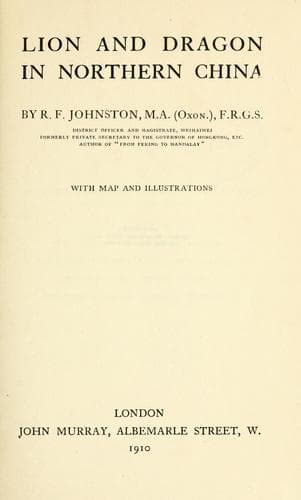
Lion and Dragon in Northern ChinaJohnston, Reginald Fleming, Sir
History
Lion and Dragon in Northern China
Johnston, Reginald Fleming, Sir
Weihai (China) -- History; Weihai (China) -- Social life and customs
Nearly all villages in Weihaiwei have certain police regulations
which are made and promulgated by the local elders. They possess, of
course, no legal sanction, though they are frequently brought to the
British magistrates for approval and to be stamped with an official
seal. They consist of lists of punishable offences, and the penalties
attached to them: the money fines being imposed by the village or
clan elders, and applied by them to local uses. There is a good deal
of variety among these village regulations or _ts'un kuei_ in respect
of penalties, though the punishable offences are everywhere much the
same. They always repay inspection, for they throw an interesting
light on the local morality and the views held by the leaders of
public opinion as to the relative seriousness of different classes of
misdemeanours. A written copy of the _ts'un kuei_ is usually kept in
the family Ancestral Temple or in the headman's house. The following is
a translation of one of these documents:
"1. Trampling on or desecrating graves or
allowing domestic animals to desecrate graves
in the ancestral burial-ground 10 _tiao_.[100]
2. Usurping portions of the common pasture
land (_mu niu ch'ang_) or ploughing up
portions thereof 5 _tiao_.
3. Removing fuel from private land without
permission, and cutting willows and uprooting
shrubs and trees 3 _tiao_.
4. Allowing mules, ponies, pigs, sheep, or
other animals to feed on private ground
without the owner's permission 3 _tiao_.
5. Stealing crops 5 _tiao_.
6. Stealing manure from private gardens 3 _tiao_.
7. Moving boundary-stones 5 _tiao_.
8. Obstructing or blocking the right of way
to the common pasture land 5 _tiao_.
If any of the above offences are committed at night-time, the
punishment is Expulsion from the Village.
If any person having committed any of these offences declares that
he will die rather than pay his fine, let him be conveyed to the
magistrate.
The following are exempted from punishment as being irresponsible
for their actions and deserving of compassion: children under
twelve, dumb people, and imbeciles."
Very serious offences, such as housebreaking, violent assault,
homicide, and offences against morality are not mentioned in the
_ts'un kuei_, as neither Chinese nor British law would recognise the
power of the villagers to take upon themselves the punishment of such
crimes. The very prevalent vice of gambling is sometimes but not always
punishable under the _kuei_. It occupies a conspicuous place in the
_kuei_ published by the East and West villages of Ch'ü-chia-chuang, of
which the following is a translation:
"1. Gambling:
(_a_) The owner of the house where
gambling takes place to be fined 30 _tiao_.
(_b_) Each gambler to be fined 5 _tiao_.
Public-domain text, read in full here on John Shaqi.
Reviews
Reviews
No reviews yet
Be the first to share your thoughts on this work.
Elsewhere in the archive
Join the Discussion
Join the discussion
Sign in to leave a comment or review.
Sign InorCreate an account