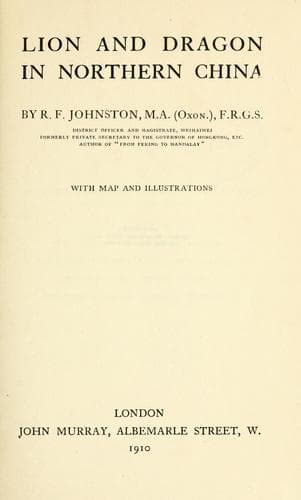
Lion and Dragon in Northern ChinaJohnston, Reginald Fleming, Sir
History
Lion and Dragon in Northern China
Johnston, Reginald Fleming, Sir
Weihai (China) -- History; Weihai (China) -- Social life and customs
We have seen that a large number of the villages of Weihaiwei are
named after the families that inhabit them. But when a single
prosperous family has "overflowed" into a number of other villages
it is necessary to differentiate between them, and the names given
have often some reference to the outward aspect of the locality.
For example, the name Sha-li-Wang-chia means the village of the
"Wang-family-who-live-in-the-sand." As a matter of fact this village
is situated near the sea-shore amid rolling sandhills, so the name is
appropriate enough. Similarly the name Sung-lin-Kuo-chia means "the
Kuo family of the Pine-grove." There are also such village names as
Willow-grove, Black Rock, Thatched Temple, North-of-the-Ku-mountain,
North-of-the-Pheasant-hill, White-pony Village. Sometimes pieces
of family-land are given fancy names for the convenience of
identification. The _Ssŭ-lao-p'o kou_ is "the ditch of the dead woman,"
apparently because a female's corpse was once found there: but as this
name struck the owner as being unlucky and likely to bring misfortune
on his family, he changed the "tone" of the first word, which
transformed the phrase into "the ditch of the four old wives."
Men have their nicknames as well as places. Such names generally
emphasise the owner's moral or physical peculiarities, and are often
highly appropriate. The name Liu T'ieh-tsui, for instance, means Liu
of the Iron Mouth--an allusion to his argumentative nature and love
of brawling. Chou Lü, or Chou the Donkey, implies just what it would
imply in England. One man writhes under the name Yü Hsieh-tzŭ--Yü
the Scorpion--because his neighbours look upon him as a poisonous
creature. Another is known as Wang Ko-p'i-tzŭ--Wang Gash-skin--because
he is possessed of a knife-like sharpness of tongue. Yet another is
spoken of as Chang T'ien Tzŭ--Chang the Son of Heaven, or Chang the
Emperor--because he is the tyrant of his village.
Public-domain text, read in full here on John Shaqi.
Reviews
Reviews
No reviews yet
Be the first to share your thoughts on this work.
Elsewhere in the archive
Join the Discussion
Join the discussion
Sign in to leave a comment or review.
Sign InorCreate an account