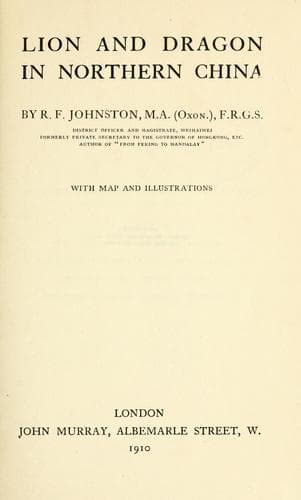
Lion and Dragon in Northern ChinaJohnston, Reginald Fleming, Sir
History
Lion and Dragon in Northern China
Johnston, Reginald Fleming, Sir
Weihai (China) -- History; Weihai (China) -- Social life and customs
Among the trees introduced since the British occupation, the acacia,
Lombardy poplar, laburnum, yew and some others thrive in the Territory,
but the oak, sycamore, elm, birch, mountain-ash and many other trees
well known in England have hitherto proved failures. From the present
denuded condition of the hills one would hardly suppose that the people
of Weihaiwei cared much for trees: yet as a matter of fact they value
them highly for their shade and for their beauty. Public opinion is
strongly averse to the wanton destruction of all trees and herbage.
An illustration of this is given in the local records. "It is a very
evil thing," says the _Weihaiwei Chih_, "to set fire to the woods and
shrubs, and pitifully cruel to the living animals that are made to
suffer thereby. In the Shun Chih period [about 1650] Chiang Ping and
his sons used to behave in this dreadful manner at Li Shan [a few miles
from Weihaiwei city]. They received numberless warnings but never would
they depart from their evil courses. One day they were going home from
market and lit a fire on the hillside. Suddenly when the fire had begun
to blaze a fierce wind sprang up, and Chiang Ping and his three sons
were all burned to death. This is a warning that men should take to
heart."
The compilers of the _Jung-ch'êng Chih_ sum up the character and
manners of the people in a way that hardly needs amplification and
shows what are the features that strike a Chinese observer as of
special interest. "They are very simple and somewhat uncouth and
unpolished," he says, "but they are honest. They have some good old
customs and show by their conduct that they are guided by the light of
nature more than by learning. The men are independent and self-reliant;
the women are frugal, modest, and are most careful of their chastity.
If they lose that they hold life as worthless. The men till the land;
the women spin. The people are stupid at business of a mercantile
nature: merchants therefore are few. Many strangers from other
districts live on the islands and in the market-centres.[110] In bad
years when the harvests are scanty and there is a dearth of grain the
hill-grasses and wild herbs are used as food. Clansmen, relatives, and
neighbours take pity on each other's distress, hence one rarely hears
of the sale of boys and girls.[111] ... Betrothals are arranged when the
principals are still in their swaddling-clothes, and thus (owing to
deaths and other causes) marriages often fail to take place. Babyhood
is certainly too early a time for betrothals.[112] There are too many
betrothals between people of different districts: hence one may find
women over thirty years of age still unmarried.[113] This tends to the
grave injury of morals. When betrothals are discussed it is considered
by all disgraceful to hold mercenary views[114] or to aim at riches and
honours. It is also considered discreditable to give a girl to a man as
a concubine."[115]
Public-domain text, read in full here on John Shaqi.
Reviews
Reviews
No reviews yet
Be the first to share your thoughts on this work.
Elsewhere in the archive
Join the Discussion
Join the discussion
Sign in to leave a comment or review.
Sign InorCreate an account