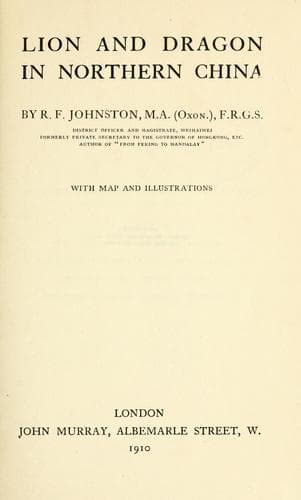
Lion and Dragon in Northern ChinaJohnston, Reginald Fleming, Sir
History
Lion and Dragon in Northern China
Johnston, Reginald Fleming, Sir
Weihai (China) -- History; Weihai (China) -- Social life and customs
The "uncouthness" of the people must be understood in a relative sense
only. In spite of the fact that the great majority are illiterate they
possess in a marked degree the natural courtesy that characterises
so many Oriental races. In considering this point with reference to
Chinese in general one must not ignore the fact that they have been
often guilty of rudeness and even savage brutality in their intercourse
with Western foreigners; but to regard rudeness and brutality as
permanent or prominent elements in the Chinese character would be
absurd, for if such were the case every Chinese village would be
in a chronic state of social chaos. Outbursts against foreigners,
however inexcusable from a moral standpoint, are always traceable to
some misunderstanding, to foreign acts of aggression or acts which
the Chinese rightly or wrongly interpret as acts of aggression, or
to abnormal political or social conditions for which foreigners are
rightly or wrongly held responsible. Most unprejudiced foreigners are
willing to admit that in normal times the Chinese are a singularly
courteous people, except when they have taken on a veneer of Western
civilisation in the treaty-ports[116] and have lost their national
graces. If the Chinese behave politely to foreigners--whom they do not
like--we may well suppose that in social intercourse with one another
their manners are still more courteous: and this is undoubtedly true.
Their rules of ceremony may seem, from the foreigner's point of view,
too stiff and artificial, or exasperating in their pedantic minuteness.
The European is inclined to laugh at social laws which indicate
with preciseness when and how a mourner should wail at a funeral,
what expressions a man must use when paying visits of condolence or
congratulation, what clothes must be worn on different occasions, how
a visitor must be greeted, how farewells are to be said, how modes of
salutation are to be differentiated and how chairs are to be sat upon.
But, after all, every race has its own code of polite manners, and
rules that impress a foreigner as intolerably formal or as ludicrous
seem quite natural to one who has been accustomed to them from his
earliest childhood. The rules of Chinese etiquette may be stiff,
but there is no stiffness about the Chinese gentleman--or about the
illiterate Chinese peasant--when he is acting in accordance with those
rules.
Public-domain text, read in full here on John Shaqi.
Reviews
Reviews
No reviews yet
Be the first to share your thoughts on this work.
Elsewhere in the archive
Join the Discussion
Join the discussion
Sign in to leave a comment or review.
Sign InorCreate an account