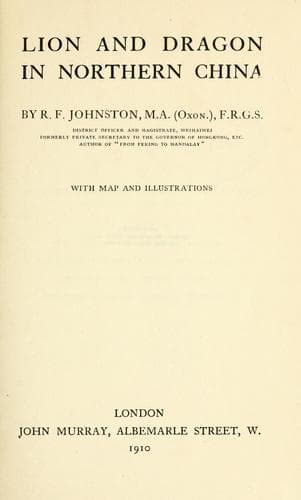
Lion and Dragon in Northern ChinaJohnston, Reginald Fleming, Sir
History
Lion and Dragon in Northern China
Johnston, Reginald Fleming, Sir
Weihai (China) -- History; Weihai (China) -- Social life and customs
Gambling has been mentioned as one of the vices of the people. That
this should be a common failing among the Chinese is not a matter of
surprise, seeing that there is probably no race among whom the gambling
instinct is not to be found. It is, perhaps, specially likely to
develop itself strongly among a people who, through lack of general
culture, are at a loss to find suitable occupations for their leisure
hours. The Chinese, however, delight in games for their own sake, as is
evident from their fondness for their own somewhat complicated forms
of chess and similar games. Serious cases of gambling are of course
punished by the law. A new penal offence is opium-smoking, which now
can be indulged in only by persons who hold a medical certificate.
According to the official lists prepared by the local Government, the
number of people who may be regarded as inveterate smokers amounts to
no more than (if as many as) one per cent. of the population: but there
is a certain amount of secret smoking and doubtless a good deal of
smuggling.
On the whole, it cannot be said that opium seems to have done any
very serious harm to the health or morals of the people of this
district,--not, at least, as compared with the havoc wrought by alcohol
in England and Scotland. If the experience of Weihaiwei goes for
anything, the view sometimes held that opium-smokers must necessarily
become slaves to the drug is an erroneous one. Many persons who were
in the habit of indulging in an occasional pipe of opium at festive
gatherings have now abjured the seductive drug without a sigh,
and--judging from a few rather ominous indications--seem inclined
to take to the wine-pot as a substitute. It may be only a curious
coincidence that while I have been obliged to punish only six Chinese
for drunkenness during a period of about five years, all six cases have
occurred since the establishment of the new anti-opium regulations in
1909.
The Chinese have great reverence for book-learning, but poverty and
the necessity for hard work from an early age have made it hopeless
for the Weihaiwei villager to aspire to erudition. Every large village
and every group of small villages have schools, but they are attended
only by a small though gradually increasing proportion of the village
children. The schoolmasters, moreover, are neither a very zealous nor
a very learned body,--not a surprising fact when it is remembered that
they receive no more than a bare living wage. At present the proportion
of villagers who can read and write is very small--probably under ten
per cent.--and even the headmen are often unable to sign their own
names.
Public-domain text, read in full here on John Shaqi.
Reviews
Reviews
No reviews yet
Be the first to share your thoughts on this work.
Elsewhere in the archive
Join the Discussion
Join the discussion
Sign in to leave a comment or review.
Sign InorCreate an account