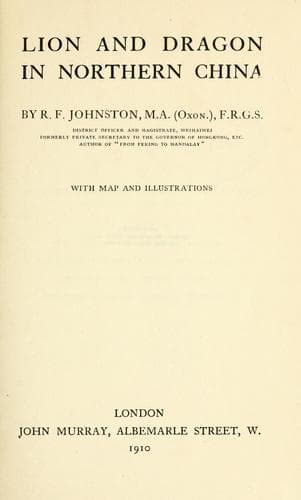
Lion and Dragon in Northern ChinaJohnston, Reginald Fleming, Sir
History
Lion and Dragon in Northern China
Johnston, Reginald Fleming, Sir
Weihai (China) -- History; Weihai (China) -- Social life and customs
The fifth month is regarded as the most "poisonous" of all the months
in the year, and antidotes and charms of all kinds are necessary to
repel the deadly influences that assail suffering humanity at this
period. Children are protected from the many dangers that surround them
by tying bands of parti-coloured silk threads round their fore-arms.
Among the most efficacious family-charms is the mugwort plant
(_Artemisia moxa_), which is hung over every doorway. Prof. Giles cites
an old saying to the effect that "if on the _Tuan Wu_ festival one does
not hang up mugwort, one will not eat any new wheat"; and explains it
by the comment that a famous rebel named Huang Ch'ao gave orders to his
soldiers to spare any family that exhibited this plant at its door.
But the superstitious use of mugwort is far more ancient than any such
story would imply. Its extreme antiquity is shown by the fact that
this plant has been similarly used as a valued charm against evil in
other parts of the world, including France, Germany and Britain.[148]
The custom in such lands was to pluck the plant at the summer solstice
(Midsummer Day) and to wear it on the person or (as in China) to
hang it over the doorway. This is only one of innumerable examples
of the strange unity that seems to underlie old popular customs and
superstitions all the world over.
In spite of the terrible potency of the evil things rampant during the
fifth month, it is supposed in Weihaiwei that from sunrise to sunset
on the fifth of the month (the festival we are now considering) all
poisonous and destructive influences--material and spiritual--totally
disappear, perhaps owing to the efficacy of the charms universally used
against them on that day. It is believed that even poisonous plants are
absolutely innocuous if plucked and eaten on the fifth of the fifth
moon, while medicinal herbs attain their supreme degree of efficacy.
Public-domain text, read in full here on John Shaqi.
Reviews
Reviews
No reviews yet
Be the first to share your thoughts on this work.
Elsewhere in the archive
Join the Discussion
Join the discussion
Sign in to leave a comment or review.
Sign InorCreate an account