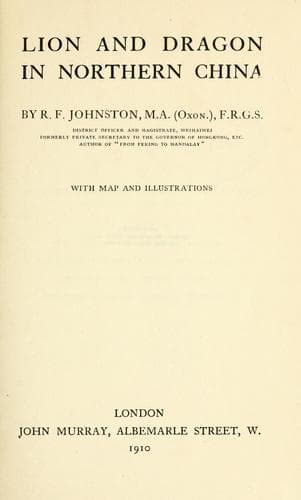
Lion and Dragon in Northern ChinaJohnston, Reginald Fleming, Sir
History
Lion and Dragon in Northern China
Johnston, Reginald Fleming, Sir
Weihai (China) -- History; Weihai (China) -- Social life and customs
A well-known custom is to rise early and walk exactly one hundred
paces into a grass-field without turning the head; then to pluck one
hundred blades of grass, which must be carefully taken home. The grass
is put into a pot of water and thoroughly boiled. The water--into
which all the virtues of the grass are now supposed to have passed--is
poured through a strainer into a second vessel, and the grass-blades
are thrown away. A second boiling now takes place, and the liquid is
poured into a bottle and kept for use as required. It is believed
to be a sovereign remedy for headaches, small wounds and bruises,
and various nervous disorders. The Chinese know it as _pai ts'ao
kao_--"hundred-grass lotion." The wise men who hand down this valuable
recipe from generation to generation are careful to explain that
the medicine will be of no avail whatever if any of the prescribed
conditions have been neglected. It is absolutely necessary to walk
neither more nor less than one hundred paces, to pluck neither more nor
less than one hundred blades of grass, and to boil and strain the water
in the manner laid down. Above all, everything must be done on the
fifth day of the fifth month, as it is only on that day that ordinary
grass possesses _ling_--spiritual or health-giving properties.
The seventh day of the seventh month is celebrated throughout China in
connection with a love-story to which allusion is constantly made in
Chinese literature. It is said that the Herd-boy (the star β γ Aquila)
and the Spinning Maiden (α Lyra), separated throughout the rest of
the year by the Milky Way, are allowed to cross a mystic bridge made
by magpies, and to meet and embrace each other on that night only. In
Weihaiwei, where there are large numbers of magpies, it is said that
not one of these birds will ever be seen on this day until after the
hour of noon: all having gone up to the skies to perform the duty of
making a bridge for the celestial lovers. The day is regarded as one of
good omen and suitable for fortune-telling and the drawing of lots.
Public-domain text, read in full here on John Shaqi.
Reviews
Reviews
No reviews yet
Be the first to share your thoughts on this work.
Elsewhere in the archive
Join the Discussion
Join the discussion
Sign in to leave a comment or review.
Sign InorCreate an account