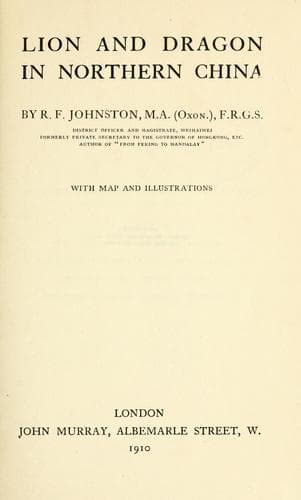
Lion and Dragon in Northern ChinaJohnston, Reginald Fleming, Sir
History
Lion and Dragon in Northern China
Johnston, Reginald Fleming, Sir
Weihai (China) -- History; Weihai (China) -- Social life and customs
On the twenty-fourth of the month every house is thoroughly swept out
in preparation for the New Year's festivities. The object of this
ceremony is not merely the practical and necessary one of cleanliness:
the sweeping process will, it is believed, rid the house of all malign
influences that may have collected there during the past year, and
thereby render it fit for the reception of every kind of joy and good
luck. This is an auspicious day for the celebration of marriages.
New Year's Eve (_Ch'ü hsi_) marks the beginning of the Chinese holiday
season, and is a day of mirth and feasting. In many families it is the
custom to sit up all night; the phrase _shou sui_ has practically the
same signification as our "seeing the Old Year out and the New Year
in." In the evening, new red scrolls, such as adorn the outside and
inside of nearly every Chinese house, are pasted over the old ones
that have now become faded or illegible. The brilliant colour of these
scrolls and the felicitous phrases, virtuous maxims and wise literary
allusions with which they abound are regarded by the common people (who
can rarely read them) as equivalent to powerful charms that will bring
happiness and good fortune to all who dwell beneath the shadow of their
influence. Fire-crackers, the delight of old and young in China, are
let off at every doorstep, helping at each explosion to dissipate any
traces of bad luck that may be lingering in the neighbourhood and to
frighten away the last malignant spirit who might otherwise mar the
happiness of the New Year.
FOOTNOTES:
[96] See pp. 336, 371-7, 382, 386 _seq._
[97] See pp. 95, 289.
[98] The same tendency, with the same result, showed itself in Burma
after the annexation to the Indian Empire.
[99] This process, whereby the expelled one ceases to enjoy the rights
to which his birth entitles him, is known as _ch'u tsu_,--"expulsion
from the clan."
[100] A _tiao_ is at present worth approximately eighteenpence.
[101] Half a _tiao_.
[102] Silk-worms are fed on the leaves of the scrub-oak on the open
hillsides.
[103] Literally, "not clear" (_pu ming_).
[104] _Han tao mi._
[105] The Government fruit-grower has recommended the Black Hamburgh,
Muscat of Alexandria and Malaya--which ripen in succession--as the
best varieties of table-grapes for Weihaiwei, while of wine-grapes the
most satisfactory are the Mataro, Alicante Bouschet, Black Malvoise,
Grenache, Zinfandel, Charbons and Johannesburg Riesling.
[106] See pp. 56, 57.
[107] The local Government--not very wisely from the point of view of
sound economics--levies small "wharfage-dues" on imported timber.
[108] This is the _pai-la shu_ so well known in Ssŭch'uan in connection
with the insect-wax industry, which is also carried on to a small
extent in Shantung though not in Weihaiwei.
Public-domain text, read in full here on John Shaqi.
Reviews
Reviews
No reviews yet
Be the first to share your thoughts on this work.
Elsewhere in the archive
Join the Discussion
Join the discussion
Sign in to leave a comment or review.
Sign InorCreate an account