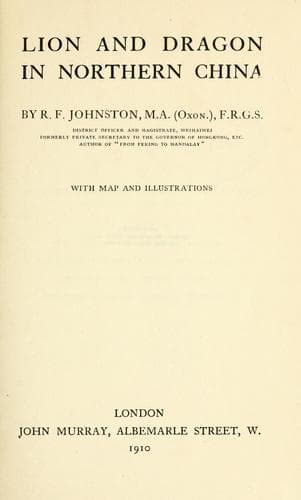
Lion and Dragon in Northern ChinaJohnston, Reginald Fleming, Sir
History
Lion and Dragon in Northern China
Johnston, Reginald Fleming, Sir
Weihai (China) -- History; Weihai (China) -- Social life and customs
[109] Probably the finest specimen of the _ginkgo_ or maidenhair tree
in the Territory is that in the grounds of Pei-k'ou Temple. Besides
being very tall, it measures fourteen and a half feet in circumference
five feet from the ground. See p. 381 for remarks on another of these
trees.
[110] For temporary purposes of trade.
[111] Sale of children by starving parents is a painful feature of
famines in some parts of China.
[112] This criticism from a Chinese writer is interesting, when we
remember that the practice is much the same throughout the greater part
of the Empire.
[113] This is exceptionally rare at the present time. The overwhelming
majority of women are married before the age of twenty-five.
[114] Mercenary views are held all the same.
[115] In proportion to the population there are very few concubines in
Weihaiwei, and most of them are imported from Peking and other places.
[116] It is a curious fact, and one never yet satisfactorily explained,
that people of non-European races all seem to lose their native grace
of manner after a period of contact with Europeans. This does not
apply to Asiatic peoples (Indian and Chinese) only: it is apparently
equally true with regard to certain African races. Miss Bleek, in a
recent work published by the Clarendon Press under the auspices of the
Royal Anthropological Institute, remarks that the Bushmen are by nature
truthful, clean, honest and courteous. "Once another Bushman visited
ours for a few days. He was so much rougher than the other that our man
was asked why his friend was different. He said, 'Missis must excuse:
this man lost his parents early and was brought up by white people.'"
[117] _The United States and China_, by Wei-ching W. Yen (American
Association for International Conciliation: New York).
[118] See illustration.
[119] See illustration. The _T'ien Kou_ is the Japanese _Tengu_. See
_Trans. As. Soc. Jap._ Pt. ii (1908).
[120] For the magic uses of peach-wood see De Groot's _Religious System
of China_, vol. iv. pp. 304 _seq._
[121] "I see no race of men, however polished and educated, however
brutal and barbarous, which does not believe that warnings of future
events are given, and may be understood and announced by certain
persons." Cicero's words, after the lapse of a couple of thousand
years, are still true. (See Cic. _de Divinatione_, i. 1.)
[122] A very similar method of divining is practised in the Malay
States. See Swettenham's _Malay Sketches_, pp. 201-7, and Skeat's
_Malay Magic_, p. 542.
Public-domain text, read in full here on John Shaqi.
Reviews
Reviews
No reviews yet
Be the first to share your thoughts on this work.
Elsewhere in the archive
Join the Discussion
Join the discussion
Sign in to leave a comment or review.
Sign InorCreate an account