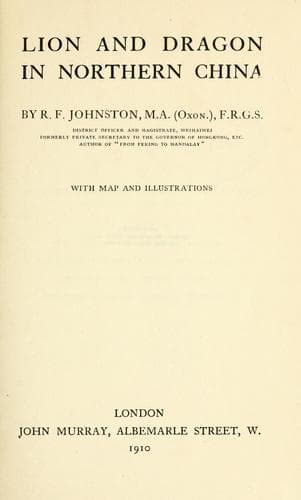
Lion and Dragon in Northern ChinaJohnston, Reginald Fleming, Sir
History
Lion and Dragon in Northern China
Johnston, Reginald Fleming, Sir
Weihai (China) -- History; Weihai (China) -- Social life and customs
[123] The following remarks in Dennys's _Folk-lore of China_ (pp. 56
_seq._) will be of interest to those who are wise enough to regard this
subject with unorthodox seriousness: "Divination is in China as popular
as, and probably more respectable than, it was amongst the Israelites
in the days of the witch of Endor, and it is not perhaps going too far
to say that there is not a single means resorted to in the West by way
of lifting the impenetrable veil which hides the future from curious
mankind which is not known to and practised by the Chinese. From
'Pinking the Bible' to using the Planchette, from tossing for odd and
even to invoking spirits to actually speak through crafty media, the
whole range of Western superstition in this regard is as familiar to
the average Chinaman as to the most enthusiastic spiritualist at home.
The coincidences of practice and belief are indeed so startling that
many will doubtless see in them a sort of evidence either for their
truthfulness, or for a common origin of evil.... It is when we come to
the consulting of media, the use of a forked stick, writing on sand,
and similar matters that the Chinese practice becomes singular in its
resemblance to superstitions openly avowed at home. I would here remark
that I am no spiritualist. But how, without any apparent connection
with each other, such beliefs should at once be found in full force
in the farthest East and the extreme West is puzzling. Is our Western
spiritualism derived from China?" It may be added that Japanese
"occultism"--to use a disagreeable but useful word--is very similar to
Chinese, and offers equally striking analogies with that of Europe.
(See Percival Lowell's _Occult Japan_.)
[124] It is not so well known that almost equally disgusting medicines
used to be prescribed in England. One writer says of some old
Lincolnshire remedies for ague that they "were so horribly filthy that
I am inclined to think most people must have preferred the ague, or
the race could hardly have survived." One of these remedies consisted
of nine worms taken from a churchyard sod and chopped up small. (See
_County Folk-lore_, vol. v, p. 117.)
[125] Tylor, _Primitive Culture_ (4th ed.), vol. i. p. 84. On this
subject see also Dennys's _Folk-lore of China_, pp. 51-2.
[126] "If the first person who enters a house on New Year's morning
brings bad news, it is a sign of ill-luck for the whole of the
year."--_County Folk-lore: Lincolnshire_, p. 168.
[127] The knots or joints of the hemp-stalk are supposed to represent
successive stages of advancement.
[128] _Ying ch'un._ The ceremonies differ from place to place in minor
details. Those here described are observed (with variations) at the
district cities nearest to Weihaiwei-namely Wên-têng, Jung ch'êng and
Ning-hai.
[129] _Ch'un Niu._
Public-domain text, read in full here on John Shaqi.
Reviews
Reviews
No reviews yet
Be the first to share your thoughts on this work.
Elsewhere in the archive
Join the Discussion
Join the discussion
Sign in to leave a comment or review.
Sign InorCreate an account